

You're reading an article on our Knowledge Hub. Clearly structured, sourced, on-brand. Looks like it was written by one person, over a few days.
The truth: four digital employees worked on this article at the same time. No human wrote the copy, no human built the hero image, no human pressed the deploy button. The board — one human — wrote a single sentence and said "go."
Today we're making that engine room transparent. Not as a glossy pitch, but as a step-by-step account. Because we believe: anyone who builds digital employees for SMBs should show how they use them themselves.
The full 14-page anatomy as a PDF
All 7 steps in detail, real screenshots, and the worked example — compact, with no marketing noise.
What this is about
We're not talking about AI tools you can install. We're talking about a system: specialized digital employees with clear roles, a tracking system, and fixed guardrails — what we call CEO locks.
The result: content production that runs in parallel instead of sequentially. That catches errors through guardrails before they happen. And that works without human micromanagement.
How exactly? We'll show you — with a real example.
The 4 digital employees
Our content team consists of 12 specialized agents. For a typical blog initiative, 4 of them are active:
Apex — CEO.
Triage, prioritization, CEO locks. Apex decides what gets produced when and how, sets the non-negotiable guardrails, and clears the final live push.
Lena — Content Writer.
Blog copy, LinkedIn posts, captions. Lena doesn't write creatively into the blue — she writes within the CEO locks: the slug is fixed, the H1 is fixed, the brand anchor is fixed. The room to maneuver is in the argument — not the framing.
Sophia — Image Designer.
Hero images, carousels, brand cards. Sophia works against the same locks: resolution, aspect ratio, brand palette. No room for interpretation on visual identity.
Uwe — Web Deploy.
Blog deploys, hub expansions, Vercel previews. Uwe pushes nothing to production without a board go-ahead. Branch preview first, approval second.
Important: everyone does exactly one thing. Lena doesn't design images. Sophia doesn't deploy. Uwe doesn't edit copy. Clear roles, no generalists.
The 7-step pipeline
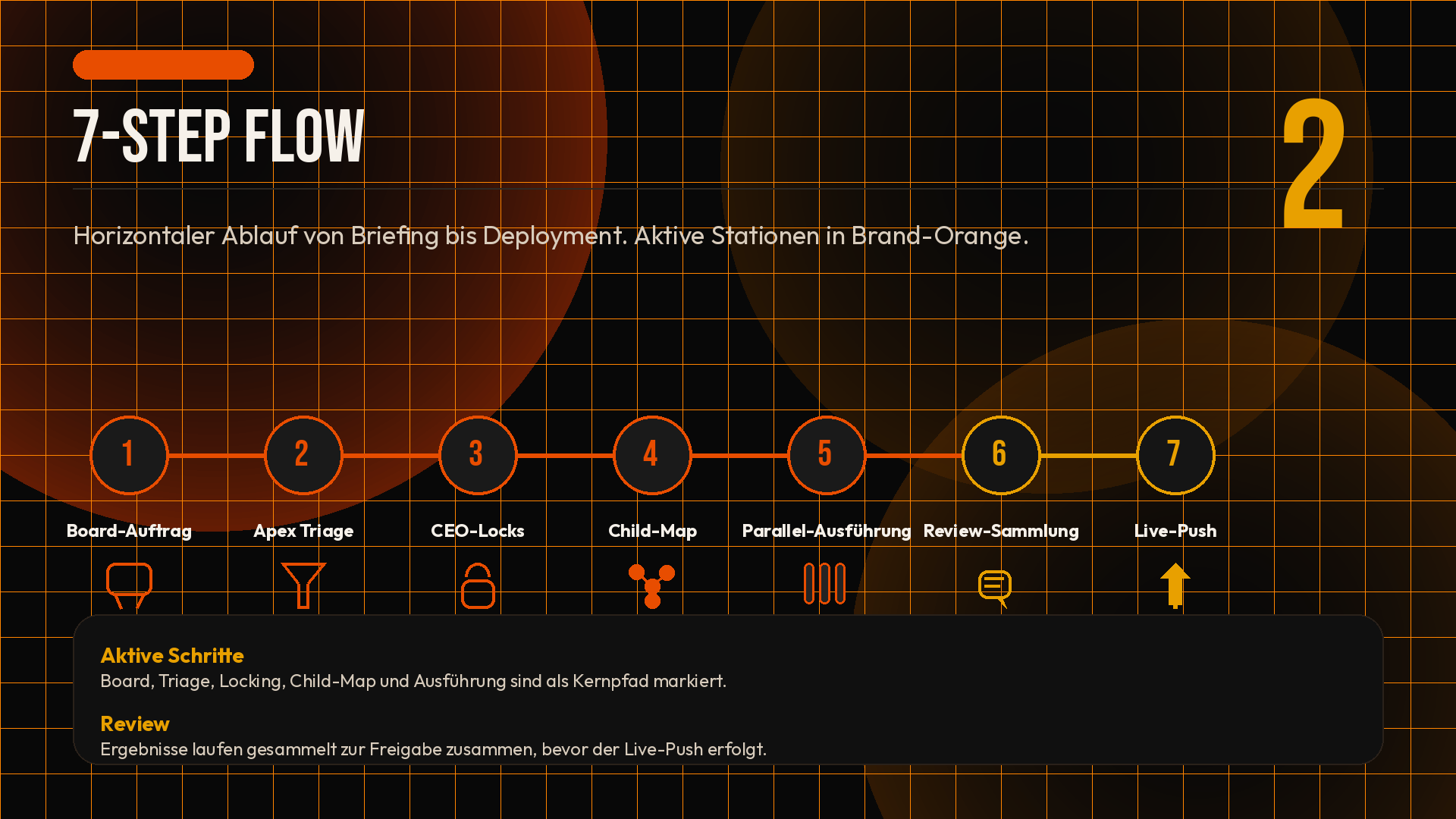
Every content initiative goes through the same flow:
Step 1 — Board brief.
A human writes a short brief into the system. No format spec, no slug, no image count. One sentence is enough.
Step 2 — Triage.
Apex asks itself 5 questions: Format? Source lock? Live state? Compliance? Language? In under a minute, it's clear what needs to be produced.
Step 3 — CEO locks.
Apex fixes the non-negotiable constants: slug, H1, brand anchor, compliance lock, language. These locks prevent downstream employees from jeopardizing brand or compliance.
Step 4 — Child map.
Apex breaks the brief down into atomic sub-tasks. Every task gets an owner, a definition of done, and — if needed — a blocker. Whatever can run in parallel, runs in parallel.
Step 5 — Parallel execution.
Lena writes copy. Sophia builds images. Uwe prepares the hub. At the same time. Three 30-minute tasks take 30 minutes in parallel — sequentially they'd take 90.
Step 6 — Review collection.
Once all deliverables are done, Apex checks each one against the CEO locks. On drift: a correction task. On approval: move on.
Step 7 — Live push.
Uwe pushes a branch preview. The board reviews it. On "go," Uwe merges to production. Apex verifies HTTP 200 and link resolution. Only then is the initiative live.
What this looks like in practice: AMAA-605
Theory is nice. Practice is better. Here's how the initiative "20 AI tools we use every day" played out:
Board brief: one sentence — "20 tools, LinkedIn, blog, and add the 20 tools to the collection."
CEO locks: slug fixed, H1 fixed, brand anchor "we build for others what we use ourselves," DE-only, compliance lock: don't frame tools as "SMB-ready" — show transparently what we actually use.
Child map: 4 tasks.
- Lena: blog copy + LinkedIn post → starts immediately
- Sophia: hero image 1920×1080 → starts immediately
- Uwe: 20 tool detail pages in the hub → starts immediately
- Uwe: blog deploy → automatically waits on Lena + Sophia
Result: 3 tasks run at the same time. The deploy automatically waits until copy and hero are done — no human polling, no "are you done yet?" The system wakes the deploy task up on its own as soon as the blockers clear.
From board brief to live: one morning.
Three principles to take away
What you can take from our pipeline and apply to your own business:
1. Clear roles instead of multitasking.
One employee, one task type. That applies to digital teams as much as human ones. Generalists sound flexible, but deliver slower and more error-prone results than specialists with a clear scope.
2. Parallel instead of sequential.
As soon as a brief breaks down into independent parts, those parts need to run at the same time. Waiting for A to finish before starting B wastes time — systematically.
3. CEO locks early, corrections late.
Fix the guardrails — brand, compliance, format — before execution, and you save yourself the re-loops at the end. One hour of triage saves five hours of rework.
Download the full 14-page anatomy as a PDF
All 7 steps in detail, real screenshots, the worked example across 14 pages — free, no email gate.
What would this look like in your business?
No pitch, just coffee and an honest conversation. 20 minutes — free.
Book a conversation →Frequently asked questions
CEO locks are non-negotiable constants fixed before execution: slug, H1, brand anchor, compliance boundaries. They prevent downstream employees — human or digital — from jeopardizing brand or legal requirements, without micromanaging every step.
From board brief to live push: one morning. Copy, images, and hub prep run in parallel. The deploy automatically waits on the deliverables — no manual polling, no status meeting.
Typically 4: Apex (CEO triage and locks), Lena (copy), Sophia (hero image), Uwe (deploy). Each has exactly one scope. No generalists, no overlapping responsibilities.
The principle — clear roles, CEO locks, parallel execution — transfers to many processes. Whether marketing, back office, or customer service: we build it together. A 20-minute conversation is enough to see where the biggest lever is.