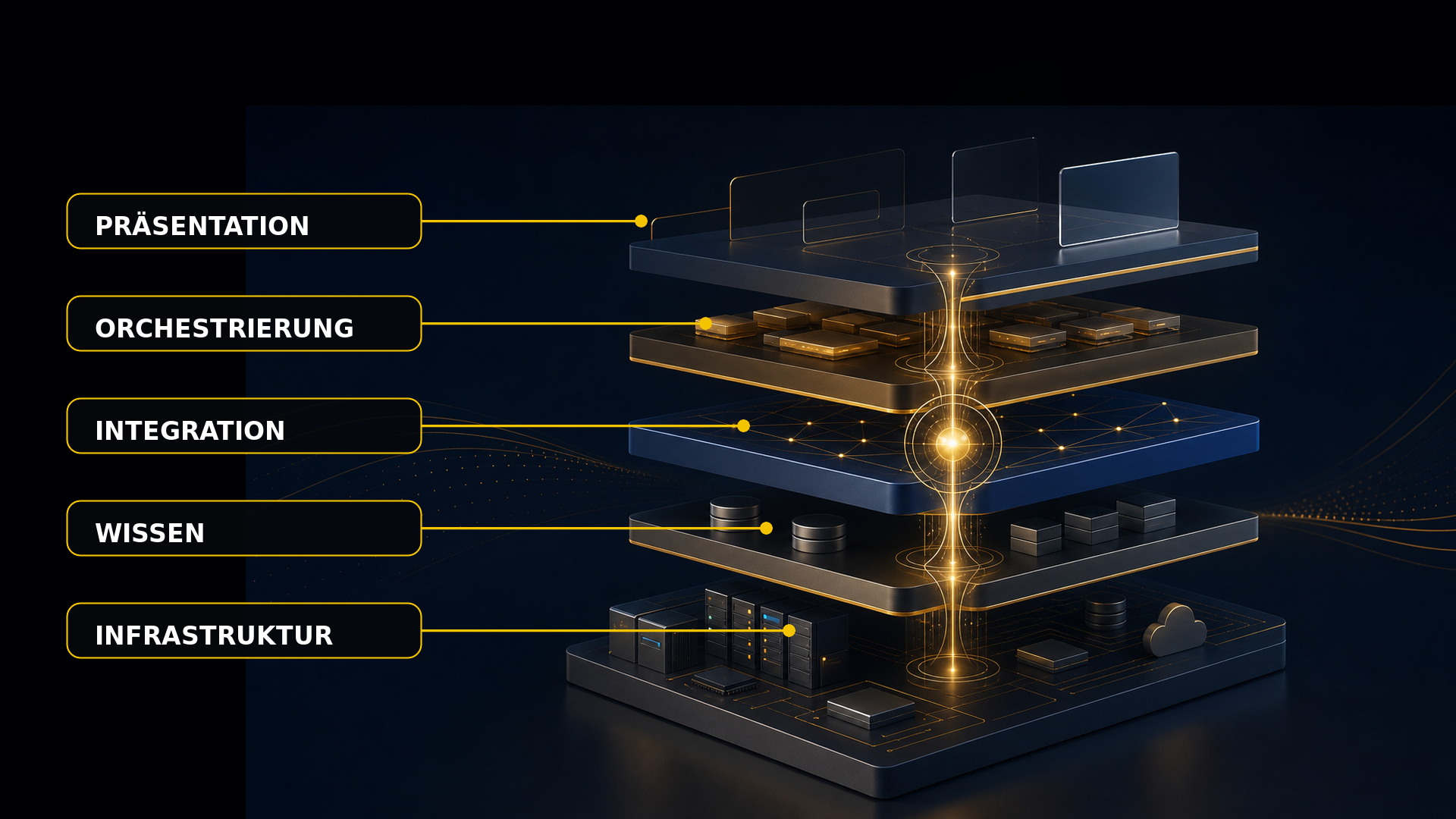

"The more autonomous a system becomes, the more its intelligence shifts out of the models and into the architecture." That's the line Sebastian Springer opens his architecture guide for AI systems with, published on heise online. The core of his thesis: the language model is not the decisive layer — it's a cognitive building block that five other layers use. For the DACH mid-market that has a clear consequence: anyone betting everything on a single model is betting on the wrong factor. At Amazing Agents, we translate Springer's theory into practice — for the 8-employee trade business and the 5-person financial advisory firm alike. We build architectures, not models.
Why "architecture > model" is now an SMB question ▲
On June 12, 2026, Anthropic blocked export of its most advanced models, Fable 5 and Mythos 5, outside the US. Opus 4.8, Sonnet 4.6 and Haiku 4.5 remained globally available — but the signal was clear: availability is not a law of nature. Anyone who had built their phone system, their lead process, or their compliance documentation on a single model suddenly faced the question: what if my provider stops delivering tomorrow?
Core answer: Multi-model resilience means Claude, GPT, Gemini and regional providers all work through the same architecture. One provider failing becomes an infrastructure question, not a model question.
Springer's 5-layer model provides the theoretical framework for that. We provide the mid-market translation. Specifically: what does the architecture look like for a trade business that takes 24/7 emergency calls? What does it look like for a §34d firm serving Germany's 178,791 §34d intermediaries (DIHK, 01/2026) under BaFin supervision — plus roughly 6,066 intermediaries in Austria and roughly 10,000 in Switzerland under their own regulators? The answer lies in five layers — and none of them is "buy the best model."
More on multi-model resilience: Anthropic export ban: why mid-market AI now needs to go multi-model
The 5 layers — from presentation to infrastructure ▲
1. Presentation — how the customer experiences the system
The presentation layer is the interface: voice, chat, SMS, WhatsApp. It's not the model that determines the quality — it's how well the system understands the input channel and formats the response.
Trade business example: Ben, our phone agent, takes emergency calls. A customer calls and says, "We've got water coming up in the basement." The presentation layer recognizes "water" + "basement" as an emergency trigger, transcribes the Swabian dialect correctly, and sends an SMS confirmation to the customer within 60 seconds. No model decides on dialect tolerance — the presentation layer does.
Financial services example: A §34d intermediary uses a chat for first-contact triage. The presentation layer shows a mandatory disclaimer: "This conversation is being recorded for quality assurance." The chat uses no advisory language — only triage language: "Would you like to review an existing policy or take out a new one?" The model supplies the text — the presentation layer formats it to stay compliant. We qualify. You advise.
Core answer: The presentation layer translates between human and machine. The model is its cognitive building block, not its replacement.
2. Orchestration — who calls which sub-agent, and when
Orchestration is the routing logic: which task gets delegated to which sub-agent? Which task stays with the main agent? Anthropic calls this "workflows vs. agents" — the orchestration layer decides when a predefined path is enough and when an autonomous agent needs to take over.
Trade business example: A customer calls about water damage and wants a quote immediately. The orchestration layer kicks off a photo-capture sub-agent: "Could you send me a photo of the damage over WhatsApp?" The sub-agent receives the image, extracts damage details (room size, affected area) and hands the result back to Ben. The main agent only sees the result — not the sub-process. Jarred Sumner ported 750,000 lines of Rust code with Claude Opus 4.8 in 11 days at a 99.8% test-pass rate — a showcase for orchestration via sub-agents. For an 8-person business, that means: sub-agents work in the background. You only see the result.
Financial services example: A first contact comes in through the form. The orchestration layer triages and routes it: existing policy → advisor A (specializes in contracts), new business → advisor B (specializes in closing), claims → advisor C (specializes in settlement). The orchestration layer stops before any product recommendation — that's where a human takes over. No model makes compliance decisions. The orchestration layer draws the stop line.
Core answer: The orchestration layer is the conductor. The model is a musician in the orchestra, not the conductor itself.
How agentic systems are used in public administration and the mid-market: GovTech Prompt-a-thon 2026 — Agentic systems for mid-sized businesses
More on Dynamic Workflows: Dynamic Workflows — autonomous multi-agent systems for mid-sized businesses
3. Integration — how the system talks to the outside world
The integration layer connects your AI to your existing systems: CRM, calendar, payment systems, tariff APIs. The model doesn't integrate — the integration layer does. The model decides when an integration gets called. The integration layer decides how.
Trade business example: Ben calls Buffer (the calendar API) to find a free slot for an appointment. The integration layer authenticates against Buffer, queries the next 7 days, filters by availability, and returns the slots. The model only sees: "Monday, 2 pm is free." The integration layer handles the API tokens, rate limits and JSON schema.
Financial services example: An advisor wants to check a customer's existing policies. The integration layer calls the DATEV interface, authenticates using BiPRO standards (the German insurance data standard), and pulls the contract list. The integration layer caches the data — not the model. The model only interprets the data. The integration layer fetches it, validates it, caches it.
Core answer: The integration layer is the interpreter between your AI and the outside world. The model is the decision-maker, not the interpreter.
More on integration in the advisor ecosystem: OpenAI Partner Network — 300,000 advisors, but who implements it?
4. Knowledge — what the system needs to know without asking every time
The knowledge layer stores structured and unstructured knowledge: FAQ documents, product databases, compliance rules, inquiry history. RAG (retrieval-augmented generation) is the standard: the model queries the knowledge layer before it answers. The knowledge layer supplies the context. The model formulates the answer.
Trade business example: A customer asks, "What does a weekend emergency repair cost?" The knowledge layer has a vector index with the price list. The model queries it: "weekend emergency-service rate." The knowledge layer returns: "Base fee EUR 150 + EUR 80/hour." The model answers: "On weekends we charge a base fee of EUR 150 plus EUR 80 per hour."
Financial services example: An intermediary wants to know whether a product is IDD-compliant. The knowledge layer has a compliance index covering §34d VVG and IDD requirements. The model queries it: "IDD compliance, product X." The knowledge layer returns: "Product X meets IDD disclosure requirements under §61 VVG." The model knows nothing about §61 VVG — the knowledge layer does.
Core answer: The knowledge layer is the memory. The model is the speaker, not the memory itself.
5. Infrastructure — what happens when a provider goes down?
The infrastructure layer is the invisible foundation underneath everything: hosting, multi-model routing, encryption, audit logs, EU region locks. Springer writes: "Infrastructure determines availability." For the DACH mid-market that means GDPR compliance, BaFin supervision, and failover resilience.
Trade business example: A customer calls while Anthropic is having an outage. The infrastructure layer detects the failure after a 2-second timeout and automatically routes the request to Gemini Omni. The customer notices nothing. The infrastructure layer logs the failover in the audit trail. The model gets swapped out — the architecture stays stable.
Financial services example: An intermediary needs to maintain BaFin-compliant audit logs. The infrastructure layer encrypts every request in transit and at rest, stores the data EU-only (Frankfurt region), and separates client data by tenant. No model decides on encryption — the infrastructure layer does. Availability is the fourth column, alongside performance, cost and GDPR.
Core answer: The infrastructure layer is the foundation. The model runs on the foundation, but it isn't the foundation itself.
Why the language model isn't its own layer ▲
Springer's central thesis: the language model is not a layer. It's a cognitive building block that several layers use. The presentation layer uses it for voice transcription. The orchestration layer uses it for routing decisions. The integration layer uses it for extracting API parameters. The knowledge layer uses it for generating queries. The infrastructure layer swaps it out when a provider fails.
In concrete terms: A trade business asks, "Which model should I buy?" The answer is: don't buy one. Build an architecture that uses several models. Claude for dialect tolerance. GPT for structured calendar requests. Gemini for image analysis on damage photos. The model is replaceable. The architecture is your competitive advantage.
Anthropic writes in "Building effective agents": "Workflows are systems where LLMs and tools are orchestrated through predefined code paths." That means: the orchestration is the code path. The model is the tool inside the code path. For an 8-person business, that means: invest in the orchestration, not in a model subscription that could be blocked tomorrow.
What DACH SMBs can do right now ▲
Springer supplies the theory. We supply the roadmap for the DACH mid-market. Here are the concrete next steps for SMBs with 5–20 employees:
- A layer audit, not a model audit. Don't ask, "Which model do we use?" Ask, "Which layers are we still missing?" Do you have a presentation layer (voice + chat)? Do you have an orchestration layer (routing logic)? Do you have an integration layer (CRM + calendar)? Do you have a knowledge layer (RAG index)? Do you have an infrastructure layer (multi-model failover)?
- Multi-model from day one. Build your architecture so you can run Claude, GPT and Gemini through the same infrastructure layer. No vendor lock-in. The export ban on June 12, 2026 was a warning shot. The next one is coming.
- Compliance as an architecture question. §34d intermediaries often ask, "Is Claude GDPR-compliant?" The right question is, "Is my infrastructure layer GDPR-compliant?" The model processes data. The infrastructure layer encrypts it, logs it, separates it. Compliance is an infrastructure question, not a model question.
- Sub-agents instead of a monolith. If you want to automate a process, ask, "Which sub-task can a sub-agent take over?" Photo capture? Calendar check? Document extraction? Sub-agents work in the background. You only see the result.
- Mind the showcase disclaimer. Jarred Sumner's Rust port was an open-source runtime proof of concept — not an 8-employee trade-business production deployment. 99.8% test-pass is impressive. 750,000 lines in 11 days is an edge case. Your trade business starts with an emergency-call agent, not a compiler port.
FAQ — Frequently asked questions ▲
What does AI architecture actually mean for a company with 5–20 employees?
AI architecture means: you're not building one system, you're building five layers that work together. Presentation (voice/chat), orchestration (routing), integration (CRM/calendar), knowledge (FAQ/RAG) and infrastructure (multi-model/GDPR). Each layer has a clear job. The language model is not a layer — it's the cognitive building block that all five layers use.
Do I need Claude or GPT for this — or both?
Both. Or more precisely: at least two providers. Multi-model resilience means: if Anthropic imposes an export ban tomorrow, your system keeps running because the infrastructure layer automatically switches over to Gemini or GPT. The model is replaceable. The architecture is your competitive advantage.
How do I get started without an IT department?
Start with one use case: emergency-call routing for trade businesses. Lead triage for financial service providers. Appointment booking for anyone. Not all five layers at once. Start with presentation (voice) + orchestration (routing). Integration (calendar) comes in week 2. Knowledge (RAG) comes in week 4. Infrastructure (multi-model) comes when the first provider fails — or you plan for it proactively.
What does a 5-layer architecture cost?
The entry offer for trade businesses and financial service providers starts at EUR 990 setup + EUR 149 per month. That covers all five layers: voice agent (presentation), routing logic (orchestration), CRM + calendar (integration), FAQ index (knowledge) and multi-model fallback (infrastructure). No model subscriptions. No hidden costs. More at /en/handwerker and /en/finanzdienstleister.
2. Anthropic — "Building effective agents," Erik Schluntz + Barry Zhang, December 19, 2024
3. Knowlee Blog — "AI Agent Platform Architecture 2026," April 2026
4. Anthropic Claude Opus 4.8 migration showcase — 750,000 lines of Rust, 99.8% test-pass rate
5. DIHK — 178,791 §34d intermediaries in Germany, as of 01/2026 (AT ~6,066, CH ~10,000, separately under their own regulators)