
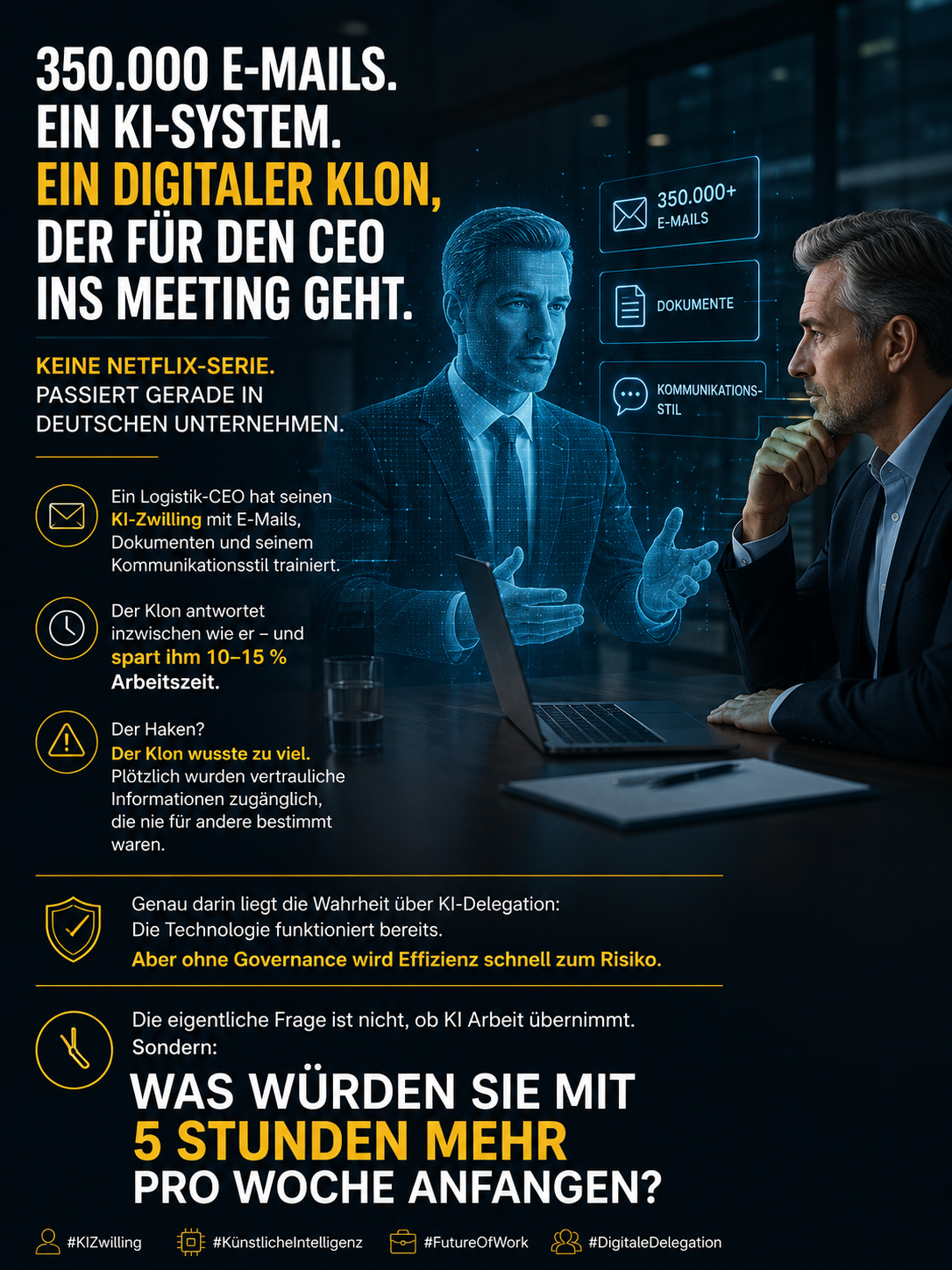
Source: „KI-Zwillinge im Büro: Wie Manager ihre Arbeit an Klone auslagern“ — Golem.de, May 2026
Mark Zuckerberg has had himself cloned. Not in a lab — by AI. Meta is training a photorealistic AI avatar of the CEO that gives employees feedback, provides strategic context, and steps in for conversations when the real Zuckerberg isn't available. What sounds like science fiction is a growing trend in 2026 — and forces every executive to ask an uncomfortable question.
The Clone Boom
At CES 2026, IgniteTech unveiled „MyPersona,“ a platform that creates digital twins from employees' voice, video, and text — in 160 languages, including facial expressions and speech patterns. Read AI offers a „Digital Twin“ that answers emails and coordinates meetings. Klarna had an AI clone of CEO Sebastian Siemiatkowski present a quarterly report to investors. Zoom and Otter.ai are testing digital stand-ins for briefings and status calls.
Gartner lists the digital replication of employees as one of the central Future of Work trends for 2026. This is no longer a niche topic — it affects every organization thinking about scale.
The headlines sound like a revolution: managers cloning themselves to get more done. But is that really the point?
The Hours Question
What fascinates executives about AI twins is a simple calculation. Every day has a limited number of hours. Anyone who sits through four two-hour meetings ends up with zero hours left for strategy, decisions, or actual leadership. The digital twin promises to break that equation: it takes over status updates, routine briefings, and recurring check-ins. The real manager focuses on what only they can do.
Sounds tempting. But a research team from Carnegie Mellon University and Emory University brought together 23 managers, executives, and employees across six design-fiction workshops — and exposed a fundamental tension.
Efficiency versus Trust
The study „When Your Boss Is an AI Bot“ shows two sides. Employees welcome AI stand-ins when they lower hierarchical barriers and deliver faster answers. At the same time, they distrust an avatar's decision-making ability — especially on sensitive topics like pay, conflicts, or strategic direction.
For managers, a different tension opens up alongside that: in the workshops, it became clear that anyone who seriously thinks about their own clone inevitably lands on the question of what purpose their own position still serves if an agent can do the job.
That's the real question. And it shows why „AI twin“ is a misleading term. A clone replicates. But what executives need isn't copies — it's tools that give them leverage.
Clone versus Agent: The Crucial Difference
An AI clone simulates a person. An AI agent gets a task done. The difference isn't semantic — it's strategic.
Anyone who clones themselves scales their habits, their blind spots, their weaknesses right along with it. The clone answers the way the boss would answer — including the emails that were better off never written, and the meeting comments that add nothing. Anyone who uses agents instead outsources specific tasks to specialized systems: research, content creation, data analysis, scheduling, reporting. Not as a copy of the boss, but as a standalone unit with a clear mandate and a measurable result.
A recent Bitkom survey underlines this: 29 percent of German employees consider their supervisors replaceable by AI. That sounds threatening — but the real takeaway is different. Employees see that a substantial share of classic management tasks is automatable. The question isn't whether executives get replaced. It's which parts of their day they sensibly hand off — and which they don't.
Takeaway for Executives
The AI twin in the office is neither a final boss nor a career turbo. It's a symptom: managers are sinking too much time into operational routine and too little into what actually makes up leadership — giving direction, setting priorities, developing people.
Anyone who wants to reclaim hours in 2026 doesn't need a copy of themselves. They need the right agents for the right tasks. That's less spectacular than an AI clone with its own face. But considerably more effective.
That's exactly the approach we take at Amazing Agents: not replicating managers — but giving them the tools that turn hours into minutes.