
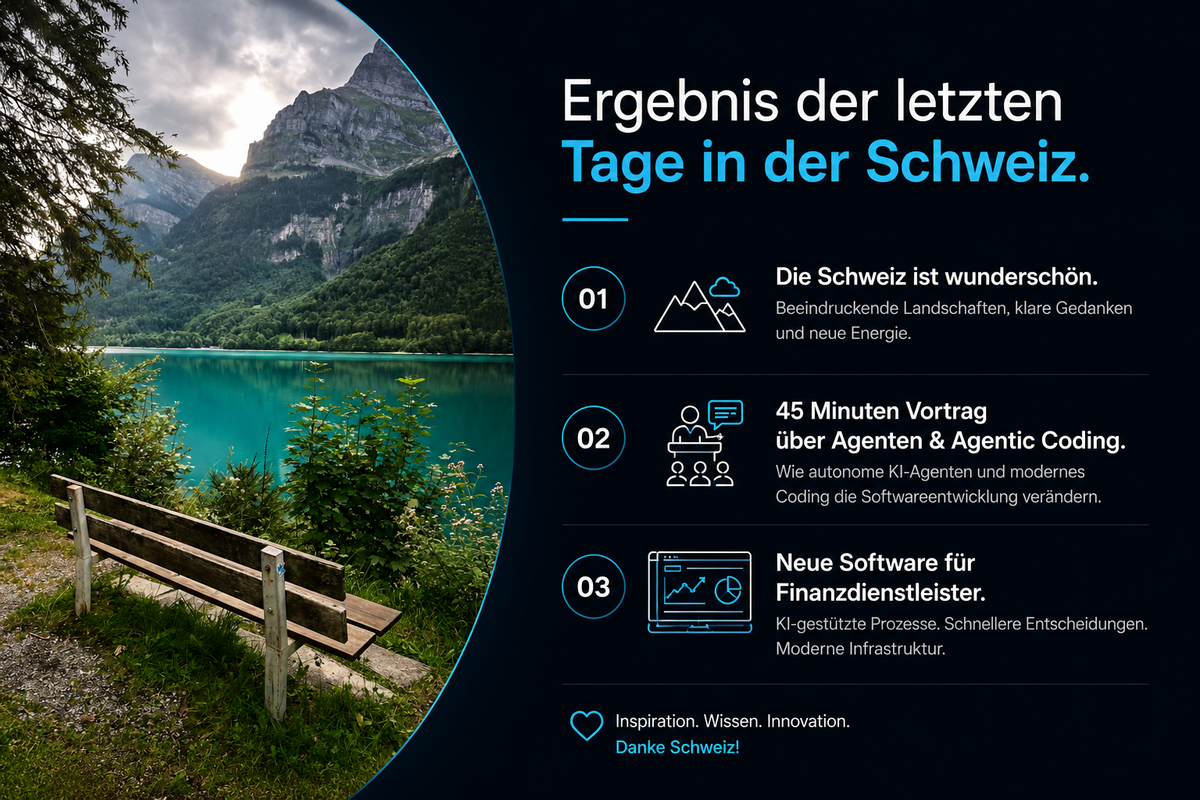
Arriving and Taking a Breath
Sometimes you need distance to see clearly. Three days in Switzerland were exactly that: no back-to-back meetings, no Slack ticker in your pocket, just mountains, quiet lakes, and time to think.
I didn't go there to hike — although the landscape would have deserved it. The occasion was professional, the effect personal. What happens when you step out of the daily grind is remarkable: your thoughts sort themselves out. What seemed urgent shrinks. What's important comes into sharper focus.
Switzerland gave me exactly that clarity. No epiphany on the summit. Just calm, good air, and a clearer head than before. That's worth more than any strategy offsite with sticky notes and timers.
Three days sounds like a little. But it's enough when the right environment comes together — no noise, no push notifications, just the murmur of a mountain lake and your own stream of thought.
45 Minutes on Agents and Agentic Coding
The actual occasion was a talk. 45 minutes on the topic that has been driving me for months: autonomous AI agents and the way they're changing software development.
Not the slide-deck version of "AI is the future." But concretely: what does it look like when an agent doesn't just generate code but makes decisions? When it retains context across tasks, recognizes dependencies, and solves sub-problems on its own?
Agentic coding means the human sets the direction and the agent finds the way. Not blindly, not uncontrolled — but independently. Once you've seen this, you don't code the way you used to.
The audience was mixed — developers, entrepreneurs, a few healthy skeptics. The best questions came from the skepticism. "What happens when the agent makes the wrong call?" A fair question. My answer: the same as with a new employee. You set clear guardrails, review the results, and adjust. The difference is the speed at which an agent learns to adapt.
What stuck with me after the talk wasn't a single slide. It was the moment a participant said: "I thought this was still two years away." It isn't. It's happening now.
And anyone who's still just watching today will have to catch up tomorrow — in a field that doesn't build in any catch-up breaks.
A Thought That Won't Let Go — Software for Financial Advisors
Between the talk and the flight home, I had a conversation that has stuck with me ever since. With someone from the financial industry. His problem sounded familiar: too many manual processes, too-slow decisions, too little time for what actually matters — advising his clients.
I know this pattern. From tradespeople. From recruiters. From anyone who spends more time on admin than on their actual work. But financial advisors have an extra layer: regulation. BaFin, MiFID II, documentation requirements. Any automation doesn't get to bypass these rules — it has to comply with them. That's the real engineering challenge.
That's exactly what we're working on. Software that takes over recurring processes without crossing the compliance line. That qualifies — not advises. That gives the advisor time back, instead of taking responsibility away from them.
What keeps me hooked on this topic: it isn't about technology for technology's sake. It's about an advisor who closes their laptop at six in the evening because their follow-up tasks are done. Automatically, in compliance with the rules, without any client having to wait.
It's not a finished product. It's a beginning with a clear thesis: financial advisors deserve better tools than Excel lists and manual follow-up routines. And the technology for it exists — you just have to put it to use the right way.
Thank You, Switzerland
Three days, three insights: distance creates clarity. Agents are changing how we build software. And there's a challenge in the financial industry waiting to be solved.
Switzerland was the right place to put it all together. Not because the answers were there — but because there was finally room for the right questions.
If you work at a financial services firm and want to know what AI-supported processes could concretely look like — write to me. No pitch, no slide deck. Just a conversation.