
Introduction
You sleep. Your agents work.
Everyone talks about AI. Few say what it gives you back in lifetime. Here's the math: 26 hours a week in repetitive tasks — that's 1,352 hours a year. 56 days of life. Over five years: 281 days you never get back. While you're reading this paragraph, an agent is answering an email, reviewing three applications, and sending out four cold-outreach sequences. No breaks. No fatigue.
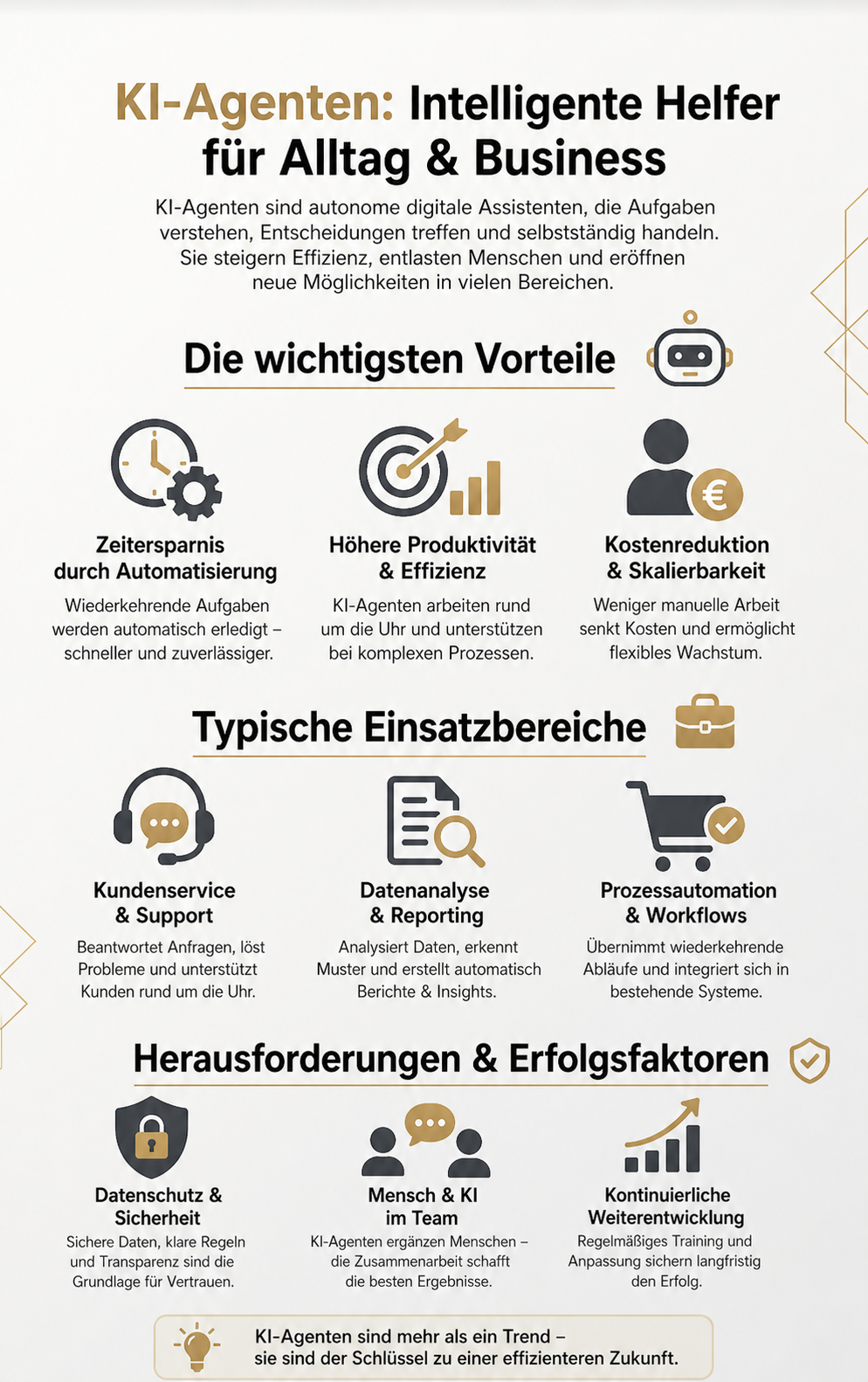
AI agents aren't chatbots that react to prompts. They're autonomous systems that plan, execute, and track tasks — over hours, days, weeks. With shared context, persistent memory, and a clear mandate. They run when your office is empty. They run on weekends. They run while you're spending time with your kids — or simply doing nothing at all.
This article shows three things: what AI agents concretely give you back in hours, where they're already running in the DACH Mittelstand today, and which factors decide between lifetime and standstill. No buzzwords. If it doesn't work, we'll say so. You stay in control.
Benefits: What You Get Back in Lifetime
A classic tool executes. An agent decides.
That's the difference. You don't write a script for every edge case — you define the goal, and the agent finds the way. Three things you get back in the first month:
1. 26 hours a week back, without hiring anyone new. Your sales run while you sleep. Your recruiting works on weekends. Your inbox isn't full in the morning — it's sorted. 26h a week, 1,352h a year — that's 56 days of life a year you get back. You pay once for the 14-day setup. The agent takes care of the rest.
2. Persistent memory. An agent doesn't forget what you explained to it last week. It remembers customer preferences, internal rules, past decisions. Unlike a static script, it gets better with every run. Unlike a new employee, it doesn't need two months of onboarding.
3. Multi-agent coordination. A single agent is nice. Several agents sharing context are a workforce. The outreach agent hands qualified leads to the sales agent. The recruiting agent coordinates with the onboarding agent. Nobody loses the thread — because there's only one source of truth, one shared memory, one audit trail. You stay in control.
You're not buying a tool. You're buying back your lifetime. 26 hours a week. 56 days a year. 281 days over five years.
Use Cases: Where Agents Already Give You Back Hours Today
I see every day what works and what doesn't. These areas measurably give clients in the DACH Mittelstand hours back:
- Email triage and replies. 200 emails a day. An agent sorts, answers recurring requests, and escalates only what genuinely needs you. Result: three hours back — per day, per person. 15 hours a week.
- Cold outreach and follow-ups. Research, personalization, sending, follow-up. An agent runs 1:1 sequences over weeks, without anyone writing "reminder for Thursday" on a sticky note.
- Recruiting and applicant pre-selection. 80 open positions, 1,500 applications, one recruiter. The agent screens, replies, schedules first interviews. What's left is what only a human can do: the final decision.
- Research and reporting. Market, competitor, and customer research. Weekly summaries from ten data sources. No more hours in Excel — just briefing and evaluation.
- Document processing. Reviewing contracts, reconciling invoices, drafting quotes. The agent does 80 percent of the groundwork. You give the approval — and sign with context, not gut feeling.
- Code and data work. Routine pull requests, database queries, reports. Tasks that cost engineering time without delivering strategic value. The agent handles them overnight.
What these areas have in common: high volume, clear rules, low variability per step — but too complex for a simple script. That's exactly where your 26 hours a week are hiding. That's exactly where three hours a day isn't rare, but standard.
Success Factors: What Makes the Difference
Three things our agents can't do — and why I say that openly: they don't replace strategy, relationships, or judgment. Once that's clear, the rest works. If it doesn't work, we'll say so. Five factors decide:
1. A clearly defined workflow. An agent is only as good as the briefing. Tell an agent to "make my recruiting better" and you get nothing. Say "for every application with more than three years of experience in X: check Y, reply with template Z, schedule an appointment in tool A" and you get a working workflow. Clarity beats complexity.
2. GDPR and EU hosting. AI agents process real customer data — names, emails, contracts, applications. Doing that in US cloud services without a clear legal basis builds you a compliance problem. EU hosting isn't a nice-to-have. It's a basic requirement. We host exclusively in the EU.
3. Persistent memory and audit trail. An agent without memory is an intern on their first day — every single day. An agent without an audit trail is a risk nobody can review. Both need to be designed in from the start, not bolted on as a feature update in month six. You stay in control.
4. Human-in-the-loop at the right points. Not every decision belongs with the agent. Contracts above a defined threshold, sensitive personnel decisions, reputation-relevant replies — these need human sign-off. The agent prepares. You decide.
5. Measurable goals from day one. No baseline, no success. We measure beforehand: how many hours does the task cost today? How many errors? How many escalated cases? How much lifetime is tied up? Only then does the agent start. Otherwise you never know how many hours it actually gave you back.
Anyone who takes these five points seriously has a running system after a 14-day setup and the first 100 hours back after 30 days. Anyone who skips them has, after 30 days, just another AI pilot that nobody will miss.
Conclusion: Get Your Lifetime Back
AI agents aren't a trend. They're an equation in lifetime. 26 hours a week, 56 days a year, 281 days over five years — the earlier you start, the more time you get back.
The Mittelstand has an advantage today that it won't have in two years: speed. Anyone who automates three workflows now will have 600 hours back in six months, plus capacity that the competitor who's still evaluating doesn't have. Anyone who waits another quarter gives away 350 hours of their own lifetime — and buys the same advantage later at a higher price.
You're not scaling — you're drowning in repetitive tasks. We give you your time back. In German. GDPR-compliant. EU-hosted. Setup in 14 days. You stay in control.