
125,000 Apps. No Code. Clear Proof.
smapOne, based in Hanover, demonstrates what many business consultants have preached for years: digitization doesn't have to be complicated for German SMBs.
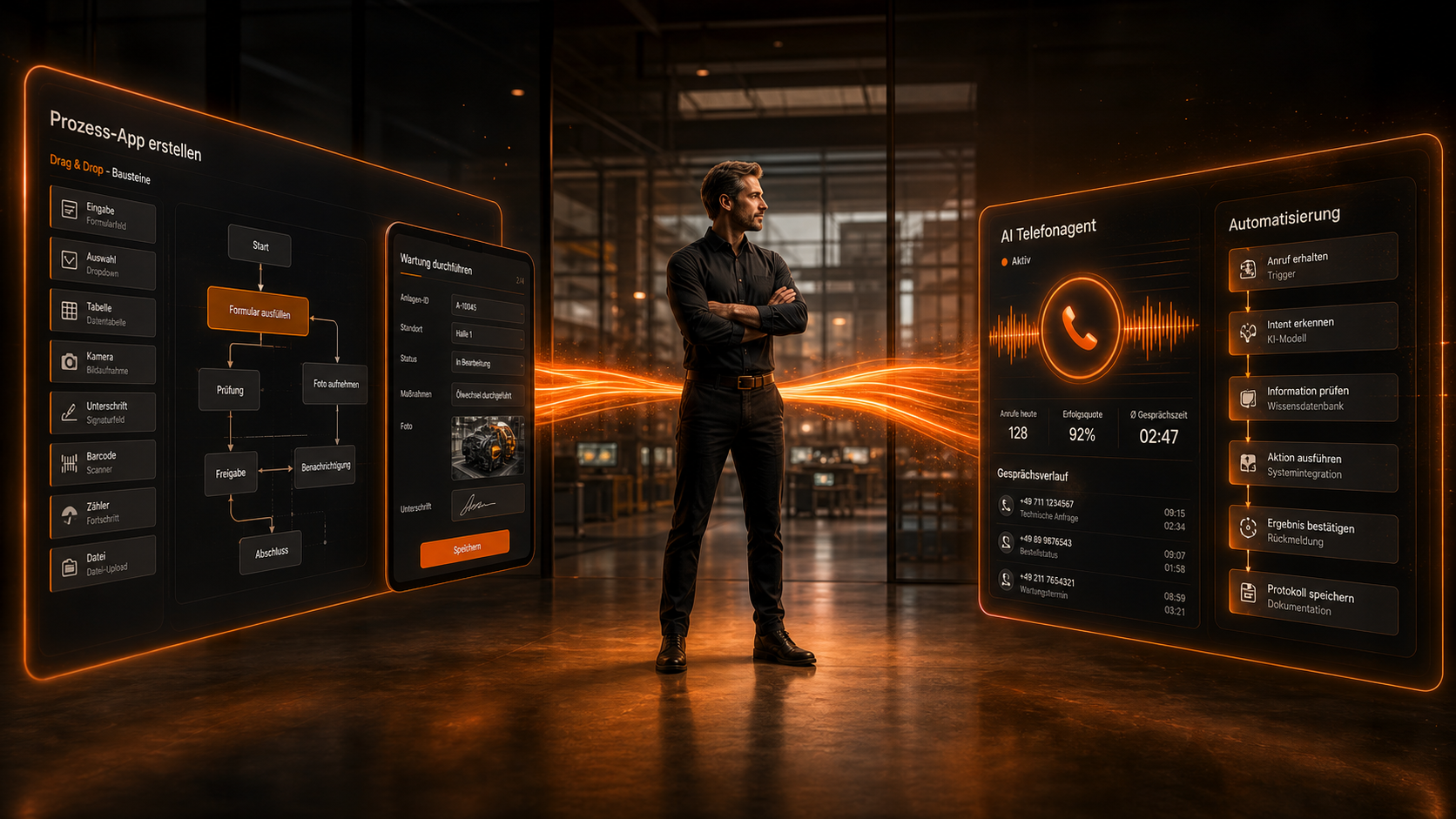
The no-code platform lets frontline staff — without an IT department, without programming skills — build their own business apps via drag-and-drop. Checklists for the job site. Maintenance logs for field service. On-site measurements at the customer's location. Damage documentation in the warehouse. All mobile, all paperless.
The numbers speak a clear language: over 125,000 active apps, around 13,500 citizen developers, and 160,000 users across the DACH region (source: smapone.com/presse, retrieved May 2026). Logistics giant DACHSER has over 1,300 citizen developers working with smapOne and reports having saved more than 13 million sheets of paper. Mid-sized manufacturer Honold built over 300 of its own apps in-house in just 18 months — without external developers.
This is no longer a pilot project. This is lived reality across German SMBs.
What smapOne gets right
smapOne solved a real problem: paper out, app in. That works on the job site, in the workshop, at the customer's location. Frontline staff document digitally instead of on clipboards. IT departments get relief. And process costs drop measurably.
A concrete example: mid-sized manufacturer Witty cuts its process costs by €80,000 per year using smapOne (smapOne case study, published 05/18/2026). That's not a promise from a keynote. That's a verified figure from day-to-day operations.
Citizen development — the idea that business departments build their own digital tools — has thus arrived among German SMBs. smapOne was founded in Hanover in 2014, today employs over 100 people, and closed a €20M funding round in 2021, led by Nordwind Capital (Business Insider, 08/08/2021). The company shows impressively: German SMBs aren't waiting for the big IT transformation. They're building their own solutions — if given the right tool.
Where no-code stops
But: smapOne digitizes what happens inside the business. On-site capture. The workflow in the field. The form on the tablet.
What about the phone?
The call at 7:30pm, when no one's left in the office. The Saturday inquiry that lands on the answering machine and is forgotten by Monday. The appointment request that costs a staff member 12 minutes, even though it could be handled in 90 seconds.
No form answers a phone call. No checklist qualifies a lead on the phone. No drag-and-drop tool books appointments while the business sleeps.
No-code solves the problem of structured data capture brilliantly. But the most unstructured, most time-consuming communication channel in the trades and SMB world — the phone — stays analog. And that's exactly where jobs get lost every day: not because the business does bad work, but because no one's there to pick up the phone.
AI agents: the logical complement
This is exactly where an AI phone agent comes in. Not as competition to no-code — as the next stage in the digitization chain.
smapOne digitizes the hours spent inside the business. An AI agent catches the hours lost on the phone.
Take Müller Heizung & Sanitär from Calw. A trades business, the kind that exists a thousand times over in Germany. Measurements? Already digital. Maintenance logs? Paperless for months. Checklists? Via app on the tablet.
But the phone? Rings into the void when everyone's out on the job site. Or an employee interrupts their work, picks up, jots the name on a piece of paper — and forgets to call back between two appointments.
With an AI phone agent, that call would be qualified, scheduled, and documented in 90 seconds — 24 hours a day, 7 days a week. No additional staff. No months of training. No app that someone first has to build.
smapOne gives the business a tool to structure workflows in the field. An AI agent structures the inbound channel — the moment before a job even enters the system.
Clipboard, app, phone agent — the chain closes
The digitization chain for German SMBs has a clear logic:
- Paper → app — smapOne and other no-code platforms have proven this works.
- Phone → AI agent — the step that's next.
- Back office → automation — the future that's already begun.
Anyone who's already taken the first step shouldn't sleep on the second. 125,000 apps prove it: German SMBs are ready to take processes into their own hands. And if a business can build 300 apps in 18 months, it shouldn't wait 18 months to get the phone under control.
The question is no longer whether German SMBs digitize. The question is which channel they tackle next. The clipboard is done. The phone is waiting.
Frequently asked questions
smapOne is a no-code platform from Hanover that lets frontline staff build their own business apps without programming skills. Target audience: DACH SMBs with field service, job sites, warehouses — anywhere paper forms have run day-to-day operations until now.
No-code apps digitize processes inside the business: checklists, maintenance logs, measurements. An AI phone agent digitizes the inbound channel: the call that comes in when no one's there. Both tools aren't mutually exclusive — they complement each other in the digitization chain.
Considerably faster than a new software solution. No development effort, no months of training, no additional staff. An AI agent answers calls, qualifies in 90 seconds, schedules and documents — 24/7, from day one.
Yes. Anyone who already runs no-code processes has already made the conceptual leap: digitization as self-ownership, not an IT project. An AI phone agent fits right into that logic — another tool that's configured and adapted in-house.
Sources:
smapOne press page: key figures (125,000 apps, 13,500 citizen developers, 160,000 users), retrieved 05/29/2026 — smapone.com/presse
smapOne case study Witty: €80,000/year in process cost savings, published 05/18/2026 — smapone.com
smapOne funding: €20M on 08/08/2021, Nordwind Capital — Business Insider, 08/08/2021