
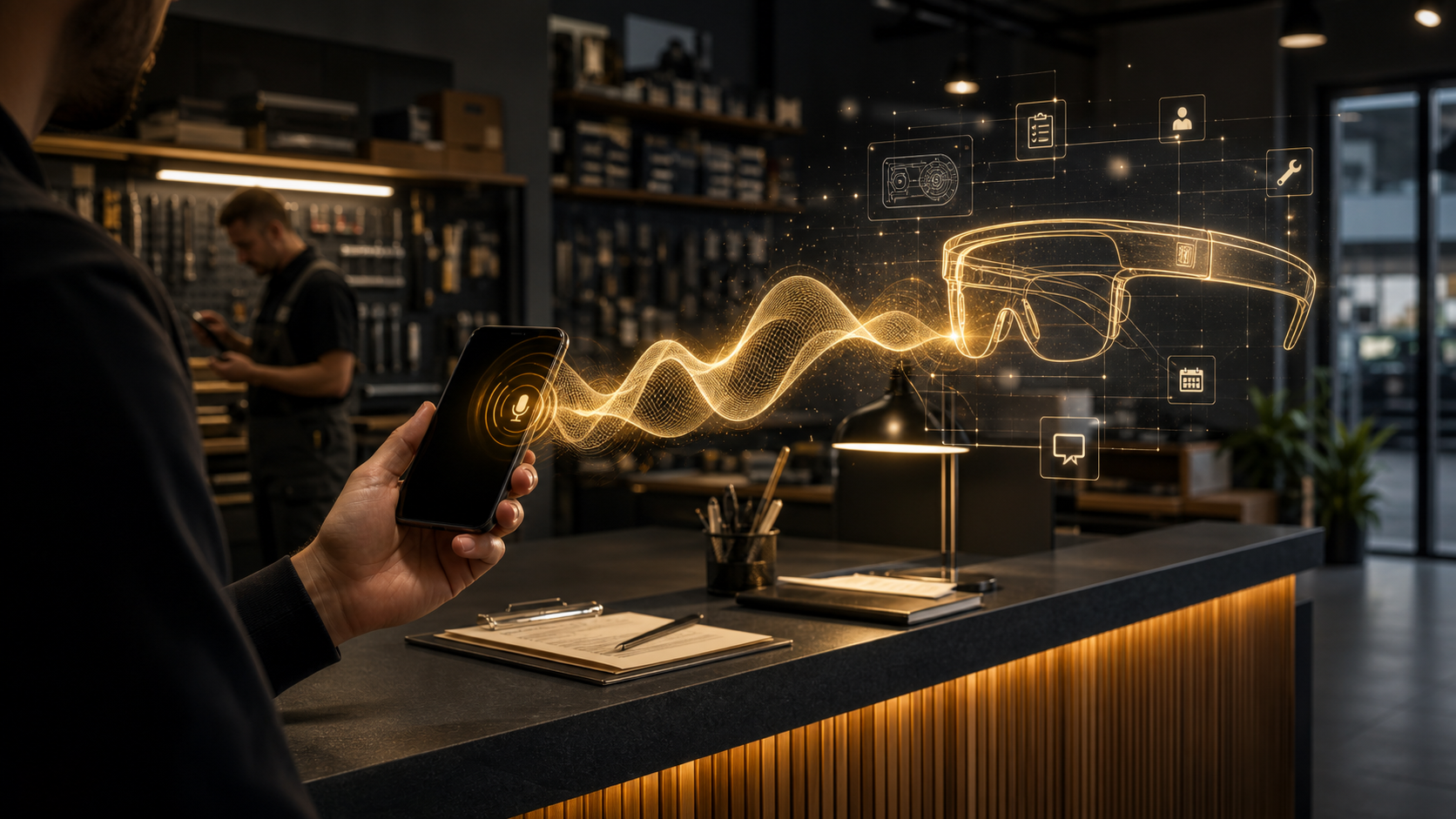
An internal memo reveals Meta's wearables push for 2026/2027. For SMBs in DACH, voice on the phone remains the faster ROI — smart glasses will arrive, at the earliest, as a second layer. Amazing Agents breaks down what the memo means for SMBs and where the adoption sequence really stands today.
Core answer: "Wearables for Work" targets enterprise pilots with ≥100 devices. For SMBs, the sequence is: voice now, vision 2027+.
What is Meta planning, according to the leaked memo?
According to an internal memo seen by The Information, Alex Himel, Meta's VP of Wearables, is planning a three-pronged push: an AI-powered pendant (AI Pendant), four new smart glasses models by the end of 2026, and a paid enterprise program called "Wearables for Work."
The AI Pendant is built on the Limitless platform, acquired in late 2025 — a clip-on audio device that records conversations, transcribes them, and creates searchable daily archives. Internal test launch: spring 2027. The smart glasses pipeline includes Modelo (June 2026), Luna and an RBM2 refresh (fall), and Mojito VIP (December). Add to that prototypes like Artemis and SSG (SuperSensing Glasses) with an all-day active camera and a contextual AI assistant.
The sales targets from the memo: 10 million wearables devices in H2 2026 and 6.8 million monthly active users by year-end.
Important: There's no official press release from Meta about "Wearables for Work." As of June 19, 2026, the about.fb.com newsroom lists none of the products named. Everything here is based on a leak — not on an approved roadmap.
Market share: Meta is defending, not triumphing
Anyone who reads the numbers can see the pattern behind the memo: Meta is reacting to lost market share.
| Period | Source | Meta share |
|---|---|---|
| H2 2025 | Counterpoint Research | 82% |
| Q1 2026 | IDC XR Tracker | 69.2% |
Within a single quarter, Meta's market share fell by nearly 13 percentage points — as RayNeo (3.4%), Xiaomi (3.1%), Viture (2.5%), and XREAL (2.0%) push into the market. IDC expects a total of 13.6 million smart glasses units for 2026 (2030: 27.3 million, CAGR 18.9%). The "Wearables for Work" initiative is Meta's response to this loss of share — not a triumph, but a defense.
Which interface layer is emerging: voice → vision
The development follows a clear sequence. First voice — that is, purely voice-based interaction with AI systems, the way it already works over the phone today. Then vision — the contextual extension through camera and sensors that process environmental information in real time.
For SMBs in DACH, this means, concretely: voice can already be deployed productively today. 89 percent of customers prefer the phone when they have a problem (BITKOM). That's why Amazing Agents puts voice-first at the top of the list: an AI phone agent like Ben handles initial qualification, scheduling, and callback management — with no new hardware, no compliance risk, and no six-figure pilot budget.
Smart glasses as a second interface layer will become relevant once the regulatory questions are resolved and adoption costs come down. But: "Wearables for Work" is explicitly targeting pilots with at least 100 devices per site at large organizations. It's not an SMB program.
Core answer: Voice-first on the phone is productive, compliant, and affordable today. Vision via wearables is coming — at the earliest 2027+, after privacy questions are resolved and works councils are on board.
DACH privacy: why Section 26 BDSG and the works council come before the purchase
The BfDI has published its own FAQ page on Ray-Ban Meta Smart Glasses. The core message: the LED indicator isn't enough for bystanders to reliably tell whether the glasses are recording.
Additional hurdles apply in the workplace:
- Section 26 BDSG (employee data protection) applies as soon as audio or video data from employees is captured.
- Section 87(1) No. 6 BetrVG requires works council co-determination when introducing "technical equipment designed to monitor employee behavior or performance."
- GDPR Art. 6 requires a solid legal basis — legitimate interest generally isn't considered sufficient for continuous audio/video recording, according to prevailing legal opinion.
The EDPB has announced its own status report on smart glasses privacy for summer 2026. Italy's Garante has already sent formal questions to Meta. Anyone budgeting a wearables strategy in 2026 without a compliance track is building a reputational risk for 2027.
What should SMBs do in 2026 — and what shouldn't they do?
Productive today: voice-first AI on the phone. A phone agent qualifies calls, answers standard questions, and books appointments — GDPR-compliant, with no hardware investment, and measurable ROI from day one.
2027+ horizon: wearable AI in field service, in the workshop, or in the warehouse — as situational knowledge hand-off, not as a replacement for functioning voice processes. Only once the regulatory guardrails are in place and the devices can be deployed in a way that's compatible with works councils.
Not recommended: budgeting AI glasses for SMBs in 2026. The adoption sequence is voice → vision, not the other way around.
Core answer: Deploy voice-first productively first — then add vision AI as a second layer. Not the other way around.
Conclusion
With the leaked memo, Meta is signaling where things are headed: AI-powered wearables as a third interface layer alongside keyboard and touchscreen. For DACH SMBs with 5 to 200 employees, that's a signal, not a call to action. Voice on the phone is available, compliant, and affordable today. Vision via wearables is coming — but after the privacy questions are resolved, after works council agreement, and after voice processes are already working.
Frequently asked questions about Meta Wearables for Work
What exactly is "Wearables for Work"?
An enterprise program reportedly planned by Meta, according to a leaked memo, that would offer smart glasses and AI pendants as a paid subscription for the workplace. It targets large organizations with pilots starting at 100 devices per site — not SMBs.
Why aren't AI glasses relevant for SMBs today?
Three reasons: adoption costs are too high, the regulatory questions (Section 26 BDSG, works council requirements, GDPR Art. 6) remain unresolved, and the enterprise program targets large corporations with ≥100 devices per site. There's no viable entry point for SMBs with 5–200 employees.
What DACH privacy rules apply to smart glasses in the workplace?
Section 26 BDSG (employee data protection), Section 87(1) No. 6 BetrVG (works council co-determination for monitoring equipment), and GDPR Art. 6 (legal basis for data processing). The BfDI also warns that the LED indicator on smart glasses isn't sufficient to reliably signal recording status.
When is the right time for vision AI in the SMB sector?
At the earliest 2027+, once the regulatory guardrails are in place and the devices can be deployed in a way that's compatible with works councils. The adoption sequence is voice → vision: first deploy voice-based AI productively, then add contextual vision AI as a second layer.
What can voice AI already deliver today?
An AI phone agent like Ben handles initial call qualification, answers standard questions, books appointments, and manages callbacks — GDPR-compliant, with no new hardware, and with measurable ROI from day one. 89 percent of customers prefer the phone when they have a problem, according to BITKOM.
Sources:
1. The Information — Meta AI Pendant Memo (via Ground News) — 05/29/2026
2. TechCrunch — "Meta is reportedly developing an AI pendant" — 05/30/2026
3. The Decoder — Meta's leaked memo reveals AI pendant, SuperSensing glasses, and enterprise wearables strategy — 05/30/2026
4. IDC — Smart Glasses Surge: XR Market Rewriting Its Own Rules — Q1 2026
5. Counterpoint Research — Global Smart Glasses Shipments Grew 139% YoY in H2 2025 — accessed 06/19/2026
6. BfDI — Frequently Asked Questions about Ray-Ban Meta Smart Glasses — accessed 06/19/2026
7. t3n — KI-Wearables: Meta soll an Anhänger und mehreren smarten Brillen arbeiten — 05/30/2026
8. Dataconomy DE — Meta plant für 2026 einen KI-Anhänger und vier neue Smart-Brillen-Modelle — 06/01/2026