
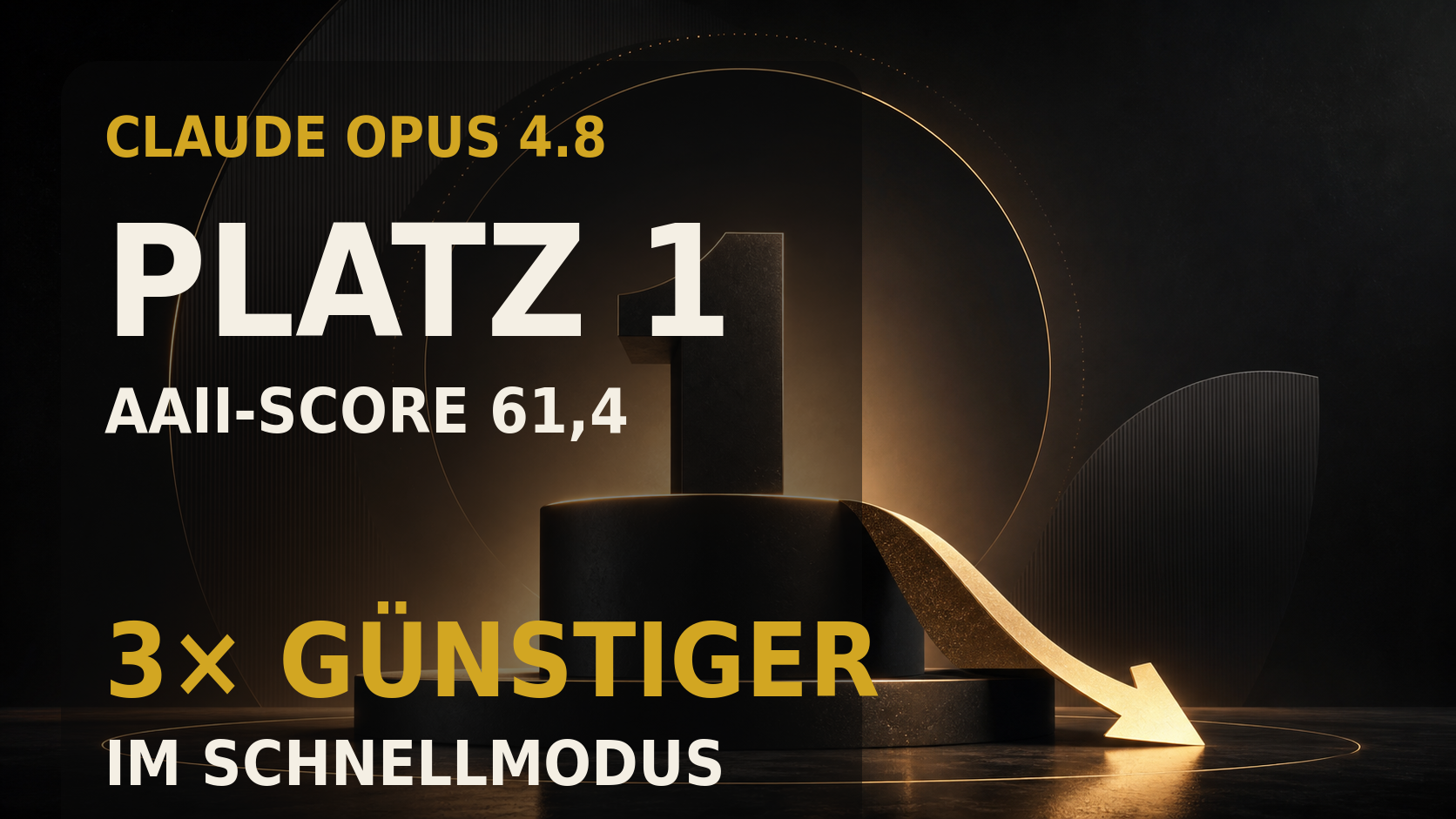
Since May 28, 2026, Claude Opus 4.8 has been the most capable AI language model on the market — measured by the Artificial Analysis Intelligence Index (AAII), the leading independent benchmark for AI models. At the same time, Anthropic has cut prices in the so-called Fast Mode by around 67 percent compared to its predecessor, Opus 4.7. For mid-sized businesses using AI-powered solutions, that concretely means: better results at the same or lower cost. And for Amazing Agents, it means the foundation we build on gets stronger — without our customers paying more.
What makes Claude Opus 4.8 the strongest model right now?
The Artificial Analysis Intelligence Index evaluates language models using standardized tests of reasoning, knowledge, and language understanding. Claude Opus 4.8 achieves a score of 61.4 points — 1.2 points ahead of OpenAI's GPT-5.5 (60.2) and 4.1 points above its own predecessor, Opus 4.7. For the first time since the index launched, a Claude model leads it.
On the GDPval-AA benchmark, which simulates real economic tasks, the gap is even clearer: Opus 4.8 achieves an Elo rating of 1,890 — 121 points ahead of GPT-5.5. This benchmark measures how well a model handles practical business tasks: data analysis, summarizing complex documents, multi-step decision processes. Exactly the tasks that come up in everyday business.
These aren't lab numbers detached from practice. Hanlin Tang, CTO of Neural Networks at Databricks, puts it this way:
"Claude Opus 4.8 sets a new bar for enterprise AI. In Genie, Databricks' AI agent for data and knowledge work, the new Opus model unlocks a step change in agentic reasoning, tackling deeper, multistep questions faster than any prior Opus."
In the same workload — multimodal reasoning over PDFs and diagrams — Opus 4.8 ran 61 percent cheaper than Opus 4.7 at Databricks.
What does the pricing actually look like?
Anthropic hasn't changed standard pricing for Opus 4.8 compared to Opus 4.7: $5.00 per million input tokens, $25.00 per million output tokens. Anyone using the previous model gets a significantly more capable model — at the identical price.
The real price jump happens in Fast Mode — the mode for time-critical applications like real-time analysis, chat interfaces, and AI phone agents:
| Mode | Opus 4.7 (input / output per MTok) | Opus 4.8 (input / output per MTok) | Change |
|---|---|---|---|
| Standard | $5 / $25 | $5 / $25 | ±0% |
| Fast Mode | $30 / $150 | $10 / $50 | −67% |
In Fast Mode, Opus 4.8 costs just a third of what its predecessor cost. For companies running real-time applications, that's a noticeable relief — with higher response quality at the same time.
Why does agentic reasoning matter for mid-sized businesses?
Agentic reasoning describes an AI model's ability to independently break complex tasks into sub-steps and work through them sequentially — without a human having to trigger every single step. What sounds abstract has direct effects on everyday business.
An example: an AI phone agent like Ben from Amazing Agents takes a call, understands the caller's request, checks internal data sources, formulates a fitting answer — and independently decides whether to forward the call, schedule a callback, or trigger an appointment booking. The better the underlying model is at agentic reasoning, the more reliable and natural this interaction becomes.
With Opus 4.8, exactly this capability improves measurably. Databricks reports "deeper, multistep questions faster than any prior Opus." That means fewer errors on nested requests and faster processing. For a trades business with 5 to 20 employees handling around 100 calls a month through an AI phone agent, the cost math looks like this:
| Opus 4.7 (Standard) | Opus 4.8 (Standard) | Opus 4.8 (Fast Mode) | |
|---|---|---|---|
| Estimated token cost/month | ~$3.00 | ~$3.00 | ~$6.00 |
| Vs. Opus 4.7 Fast ($18) | — | — | −67% |
In Standard mode, the business pays identical token costs and gets a significantly more capable model. In Fast Mode, costs run around $6 a month instead of $18 under Opus 4.7 — a saving of roughly $12 a month, with better answer quality.
What's changing at Amazing Agents?
Amazing Agents uses Claude as its core model for its AI solutions — including for Ben, the AI phone agent for mid-sized businesses, and for internal content and analysis work. Opus 4.8 has been the default model in Claude Code, the development tool Amazing Agents uses to build and evolve its solutions, since calendar week 22 (May 25–29, 2026).
This isn't a relaunch. It's an update: the existing infrastructure benefits directly from the higher reasoning quality — and, in Fast Mode, from the reduced costs. What we've said since our April launch still holds: we build for others what we use ourselves. When the tool gets better and cheaper, we pass that on.
A fair comparison: Opus 4.8 and GPT-5.5
A ranking is a snapshot. OpenAI's GPT-5.5 is close behind, with an AAII score of 60.2 — a gap of 1.2 points. Opus 4.8's lead is real, but not an insurmountable one.
What makes the difference right now: the clear lead in agentic reasoning (GDPval-AA: +121 Elo points) and the combination of top performance and cost structure. In standard pricing, no other model offers these benchmark results at the same token price. In Fast Mode, the aggressive price cut adds to that. This combination — performance plus price — is the real competitive advantage.
What does this mean for your company?
If you already have AI-powered processes in place, or are considering them: with Opus 4.8, quality improves automatically — no migration, no extra cost on the standard plan. For companies relying on real-time applications, the Fast Mode price cut is an added bonus.
Two ways to check this concretely: schedule a short call where we walk through your use case — or try Ben, our AI phone agent, free in a demo setup. No contract, no risk, 15 minutes is enough.
FAQ
What is Claude Opus 4.8?
Claude Opus 4.8 is Anthropic's most capable language model, released on May 28, 2026. It leads the Artificial Analysis Intelligence Index with a score of 61.4 and is the default model in Claude Code, Anthropic's AI-powered development environment.
How much does Claude Opus 4.8 cost?
In Standard mode, $5.00 per million input tokens and $25.00 per million output tokens — identical to its predecessor, Opus 4.7. In Fast Mode, it costs $10.00 (input) and $50.00 (output) per million tokens — a third of the predecessor's price.
Is Claude Opus 4.8 worthwhile for small and mid-sized businesses?
Yes. In Standard mode, SMBs get a more capable model at no extra cost. In Fast Mode, token costs drop by around 67 percent. For typical applications like AI phone agents, monthly costs stay in the single-digit dollar range.
What does agentic reasoning mean?
Agentic reasoning describes an AI model's ability to independently plan and execute multi-step tasks — for example, taking a customer call, understanding the request, checking internal data, and triggering an action, without human intervention at every step.
How does Claude Opus 4.8 compare to GPT-5.5?
Opus 4.8 leads GPT-5.5 by 1.2 points on the AAII (61.4 vs. 60.2). On the GDPval-AA benchmark for real economic tasks, the gap is 121 Elo points (1,890 vs. 1,769). Both models are highly capable; Opus 4.8 currently leads both rankings.
Sources:
Anthropic — Introducing Claude Opus 4.8, 2026-05-28 — anthropic.com
Artificial Analysis — Claude Opus 4.8 Analysis and Benchmarks, 2026-05-28 — artificialanalysis.ai
Artificial Analysis — AAII ranking on X, 2026-05-28 — x.com/ArtificialAnlys
Anthropic — Claude Code What's New, Week 22, 2026-05-29 — code.claude.com
VentureBeat — Anthropic's Claude Opus 4.8 with 3X cheaper fast mode, 2026-05-28 — venturebeat.com