
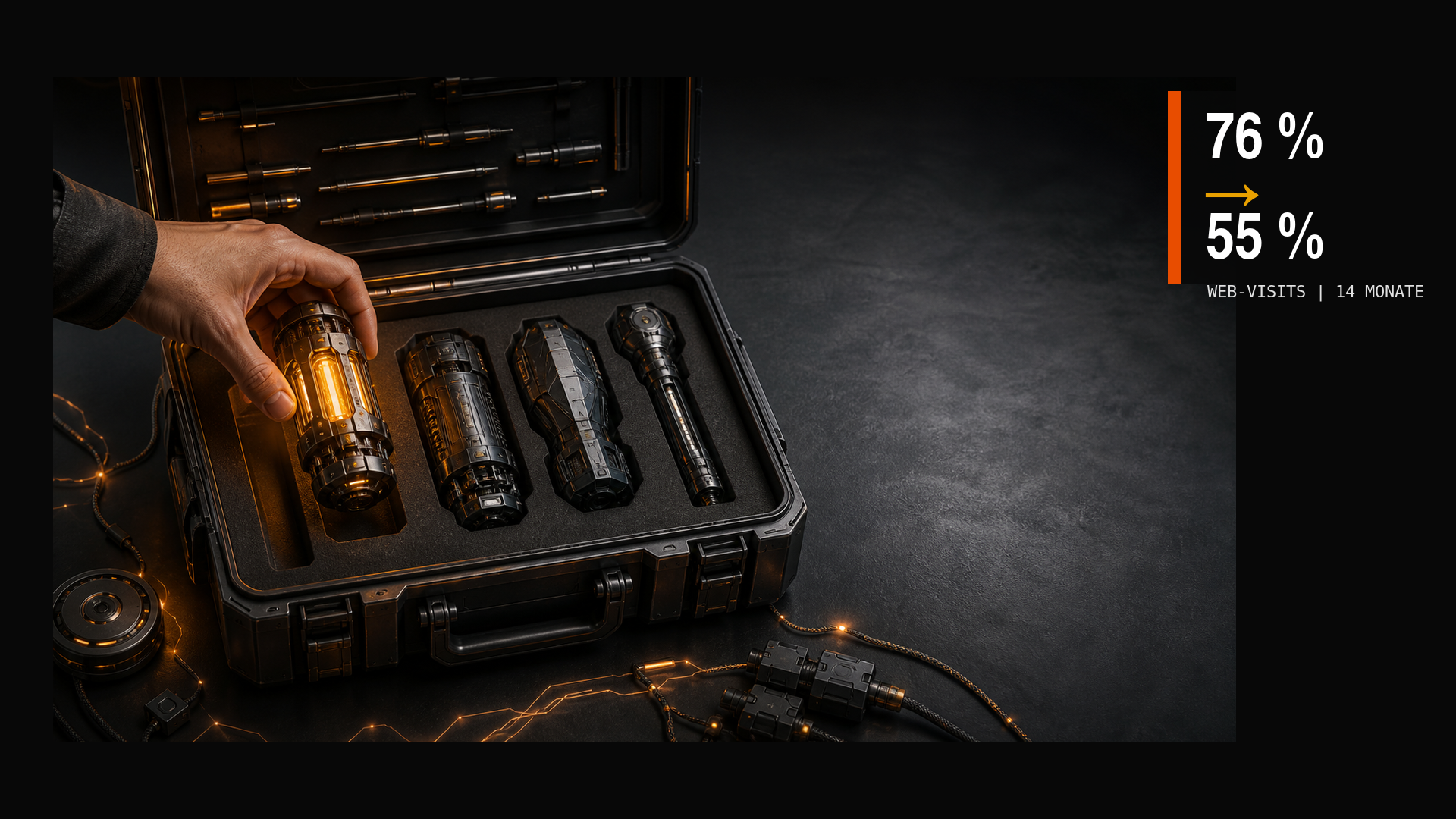
ChatGPT has lost over 20 percentage points of market share in 14 months — from 76.5 to 54.7 percent of web visits among the seven largest AI chatbots. That doesn't mean ChatGPT got worse. It means the AI market is growing up — and companies that rely on a single model have a strategic weak point.
What do the numbers say — and what don't they say?
In February 2025, ChatGPT accounted for 76.5 percent of all web visits among the seven largest AI chatbots. By April 2026, it's down to 54.7 percent — a decline of 21.8 percentage points in 14 months (Similarweb, April 2026).
The winners of the redistribution:
| Chatbot | Share, April 2026 | Web visits/month |
|---|---|---|
| ChatGPT | 54.7% | 5.51B |
| Google Gemini | 27.4% | 2.76B |
| Claude (Anthropic) | 8.2% | 824M |
| DeepSeek | 4.1% | 411M |
| Grok (xAI) | 2.8% | 279M |
| Perplexity | 1.5% | 155M |
| Microsoft Copilot | 1.3% | 130M |
Claude grew 306 percent in the first quarter of 2026. Gemini gained 104 percent in six months. And even ChatGPT's absolute visit numbers have risen 84 percent since September 2024 (Similarweb). The pie is getting bigger — but ChatGPT is getting a smaller slice.
Important: Similarweb measures only web visits to chatgpt.com, claude.ai, gemini.google.com, and the other chatbot websites. Native mobile apps, API usage, enterprise integrations, and embedded interfaces like Copilot in Microsoft 365 are not included. The 54.7 percent describes the consumer web product — not total model usage across businesses.
Why one model is no longer enough
Yesterday we reported on Satya Nadella's statement that companies would "max out every available token" in 2026 — regardless of provider. Today's numbers deliver the data-driven proof.
No model is the best at everything. A phone agent needs low latency and natural German speech output — where milliseconds decide. A compliance analysis in financial sales needs diligence and source accuracy — where the hallucination profile matters. A recruiting screen needs structured data extraction — where the model that delivers the most reliable JSON is what counts.
The question is no longer "Which AI model do we use?" It's: "Which model fits which step of the work?"
At Amazing Agents, we've worked with a multi-model stack since day one: Claude for analytical depth, GPT-5 for conversation, Gemini for multimodal tasks, specialized models for voice. Not because we can't decide — but because every use case has its optimal model.
How Germany's mid-market is already working multi-model
The Bitkom AI Study 2026 confirms it: 41 percent of German companies actively use AI. In their corporate stacks, it isn't one vendor that dominates, but the combination:
- 71 percent use ChatGPT (OpenAI)
- 50 percent use Google Gemini
- 43 percent use Microsoft Copilot
The total exceeds 100 percent — clear proof that companies are already running multiple models in parallel. Multi-model is no longer a strategy recommendation. It's reality.
At the same time, 33 percent of companies report that AI turns out more expensive than expected (Bitkom 2026). One reason: they're paying for model capacity they don't even need for certain tasks — because everything runs through one vendor instead of picking the right model per workflow.
What this means for your AI strategy
ChatGPT's falling market share is not a signal against OpenAI. It's a signal of market maturity. As with cloud providers, ERP systems, or databases, there's no longer "the one solution" — there's the right solution per requirement.
For the mid-market, that means concretely:
- No vendor lock-in on AI models. Anyone who bets everything on one model today has a negotiating and quality problem tomorrow.
- Use-case-based model choice. Your phone agent, your document analysis, and your recruiting screen don't need the same model.
- Orchestration instead of a single tool. The value lies in the architecture that coordinates multiple models — with GDPR-compliant data handling, traceable decision paths, and human oversight.
Amazing Agents builds exactly that: specialized AI agents like Ben for first contact on the phone, Tom for automated dunning, Sara for recruiting qualification. Every agent uses the model best suited to its job. Not the best-known one — the best-fitting one.
Effort × automation = freedom. And freedom also means the freedom to choose the right tool.
Instead of routing every task through a single AI provider, the optimal language model is chosen for each step of the work. 71 percent of German companies already use several AI models in parallel (Bitkom 2026).
No. ChatGPT's absolute usage numbers keep rising — up 84 percent since September 2024. The falling market share shows that alternatives like Claude, Gemini, and Grok are growing faster. The market is fragmenting, as is typical in maturing technology markets.
There's no universally "best" model. For voice applications, latency matters. For compliance analyses, accuracy matters. For recruiting screens, structured data extraction matters. That's why Amazing Agents chooses the optimal model per agent and use case.
GDPR compliance doesn't depend on the model, but on the architecture: EU hosting, data processing agreements, data minimization, and traceable decision paths. A multi-model orchestration with clear data handling is safer than a vendor lock-in with uncontrolled data flow.
Often less than a single-model strategy. 33 percent of companies report that AI turns out more expensive than expected — often because they pay for model capacity they don't need. The right model choice per workflow optimizes cost and quality at the same time.
Sources:
1. Generative AI Statistics: Market Share & Trends — Similarweb, April 2026
2. Top AI Chatbots & LLMs by Market Share — Momentic Marketing, 2026
3. ChatGPT's Market Share Falls to 68 Percent — The Decoder, January 2026
4. ChatGPT Market Share: OpenAI Rivals Close the Gap — Fortune, February 2026
5. German Companies and AI Adoption — Bitkom Research, 2026
6. Bitkom Study: AI Usage in Germany 2026 — Connect, 2026