

Anthropic launched a survey among Claude users in April 2026 and published it in June 2026. The sample comprises about 9,700 people who had at least five Claude sessions. Around 50% say AI can handle 30% or more of their work. What sounds like an automation breakthrough is, in reality, the picture of a power-user bubble — with direct implications for DACH SMBs, who are standing somewhere else entirely.
What does the Anthropic Economic Index study say? ▲
Core answer: The Anthropic Economic Index study surveyed about 9,700 Claude users. Around 50% say AI can handle 30% or more of their work — a self-assessment within a self-selected sample, not representative of the general population.
The survey captures usage patterns from Claude.ai, Cowork, and Claude Code — across free as well as Pro and Max plans.
The key findings:
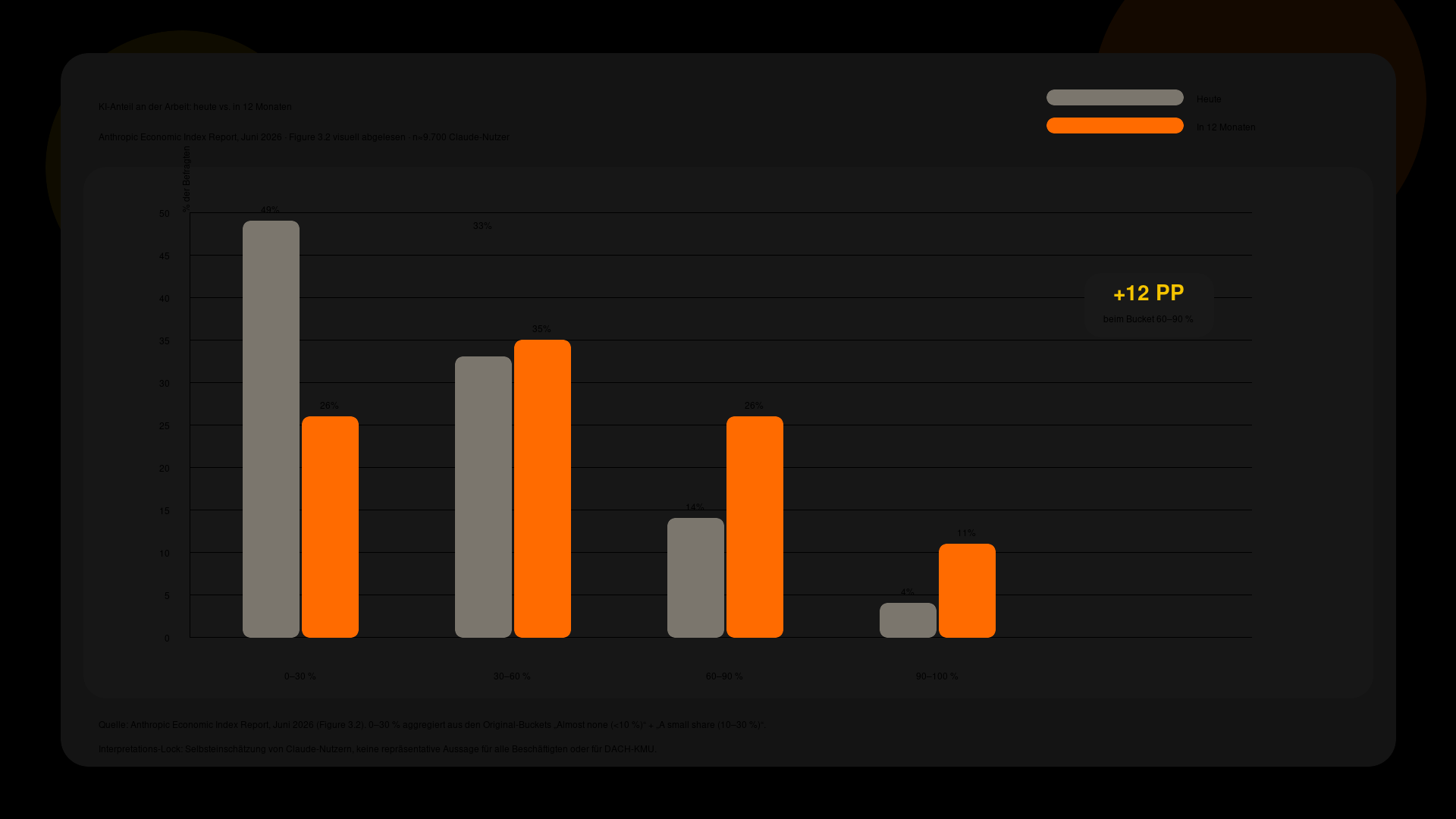
- Today buckets: About 33% of respondents say AI can handle 30–60% of their work. Around 14% cite 60–90%, and about 4% see their entire job as automatable.
- 12-month expectation: Around 26% expect AI to handle 60–90% of their work a year from now. Almost 60% pick a higher automation level than today.
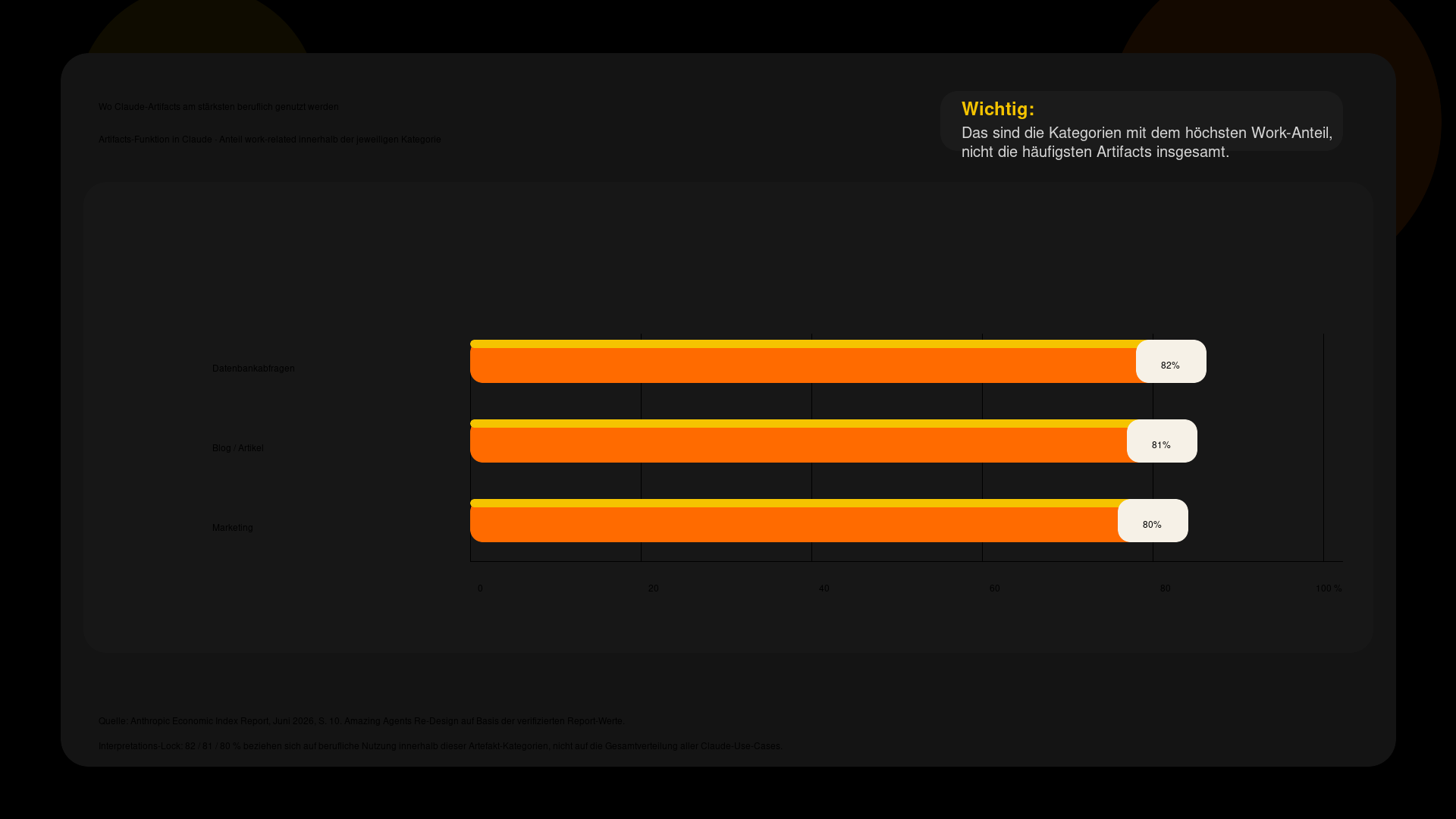
- Top use cases: The highest work-related shares among Claude artifacts are in database queries (82% used professionally), blogs and articles (81%), and marketing content (80%). The most common artifacts overall are explanations (17%), documents and reports (15%), and guidance (11%).
Important context: Anthropic itself flags the study as "not representative." The sample is heavily concentrated in computer/math occupations (about 30% vs. 4% of US employment) and management (23% vs. 7%). Industries like construction, transportation, and food prep are explicitly underrepresented.
The numbers show what Claude power users experience — not what's landing in the DACH mid-market.
What does DACH reality look like in comparison? ▲
Core answer: The DACH mid-market sits well below the Anthropic bubble. Financial advisors at 35% active AI usage, trades at 4%, construction at 8%. The adoption gap is large — and that's exactly where the opportunity lies.
While Anthropic power users talk about 50% automation, DACH studies paint a different picture:
Financial advisors:
- AfW Vermittlerbarometer 17 (n>1,100, published May 2025): 35% active AI usage, doubling from 16%. Of those, 10.5% use AI daily.
- Reality: Germany's 178,791 §34d insurance intermediaries are operating far below the 50% mark from the Anthropic study.
Trades:
- Bitkom (n=504 phone interviews, 2026): 4% AI usage, 89% see an opportunity, but implementation is missing.
- KfW Research, Fokus Volkswirtschaft No. 533 (02/11/2026): construction trails at 8% AI usage, mid-market average 20%.
Sovereignty and compliance:
- Bitkom (06/17/2026, n=603, companies with 20+ employees, representative): 85% see themselves as too dependent on US cloud, 91% want German cloud solutions, only 53% have them. 64% must review their strategy because of US policy.
Training and upskilling:
- TÜV-Verband (Forsa, n=500, companies with 20+ employees, 2026): 27% plan AI training (double the 12% in 2024), only 9% have a concrete plan.
The gap is large. Anthropic measures its own bubble. We measure your industry. The underrepresented groups in the Anthropic report — construction, transportation, the insurance-broker trade — are exactly the verticals where DACH SMBs have catching up to do.
More on our verticals: solutions for financial advisors and AI assistants for tradespeople.
What anchors can DACH SMBs take from the study? ▲
Core answer: Three anchors — Anthropic measures a bubble, not an industry. Whoever automates 50% has to reorganize 50% of the responsibility. Computer/math at 30%, construction at 0% — that's exactly where we start.
Anchor 1: Anthropic measures its own bubble — we measure your industry.
The 33%/14%/4% buckets apply to Claude power users. Computer/math occupations make up 30% of the sample vs. 4% of US employment. Management is 23% vs. 7%. Construction, transportation, and food prep are explicitly underrepresented. DACH SMBs in trades and financial services aren't in this sample at all.
The opportunity: the adoption gap isn't a lag — it's untapped potential. Where power users sit at 50%, the DACH mid-market sits at 4–35%. The question isn't "why are we slower?" — it's "how do we systematically catch up, with the BfDI, §34d VVG, GDPR, and DPAs in place?"
Anchor 2: whoever automates 50% has to reorganize 50% of the responsibility.
Anthropic finds: "heavier delegators" are more optimistic — but "skill erosion is not ruled out." DACH context: Bitkom shows 85% US-cloud dependency, 91% wanting German cloud solutions. Responsibility in DACH is more heavily regulated (BfDI, §34d, IDD). Automation without a compliance strategy creates liability risk.
The opportunity: multi-model resilience is standard. Anyone relying on a single US model carries a sovereignty risk. Anyone running several models in parallel has a fallback. More on this: the Anthropic export ban and multi-model strategy.
Anchor 3: computer/math at 30% — construction at 0%. That's exactly where we start.
The Anthropic study shows: whoever already uses Claude sees potential. Whoever isn't in the sample hasn't tapped that potential yet. DACH trades (4% AI usage) and financial advisors (35% active, but far below 50% automation) are the underrepresented groups.
The opportunity: our verticals address exactly this gap. Trades need voice-first solutions (calls, appointments, emergency dispatch). Financial advisors need compliance-ready lead qualification. Both groups are underrepresented in the Anthropic report — and that's exactly where we come in.
Related articles: ChatGPT market share and multi-model strategy for the mid-market and model choice with conviction — Anthropic Claude in June 2026.
FAQ — Anthropic Economic Index and the DACH mid-market ▲
Does the Anthropic study say that half of all workers can automate 50% of their work?
No. The Anthropic study measures a self-selected sample of about 9,700 Claude users, who are significantly overrepresented in fields like computer/math (~30% of the sample vs. 4% of US employment) and management (23% vs. 7%). About 50% of the Claude users surveyed say AI can handle 30% or more of their work. This figure does not transfer to the DACH mid-market.
Does that mean 4% of jobs will be completely replaced?
No. The 4% means that about 4% of Claude power users say AI could handle their entire job — as a self-assessment in a self-selected survey. That is not a forecast about real job replacement. Anthropic itself puts the job-loss expectation at 10%, describing it as "slightly below the US separation rate."
Are database queries, blogs, and marketing the most common Claude use cases?
No. The most common Claude outputs in Chat + Cowork are explanations (17%), documents/reports (15%), and guidance (11%). The figures 82%/81%/80% indicate the work-related share within the categories of database queries, blogs, and marketing content — i.e., how much of these three artifact types is used professionally (vs. personally).
What does this mean concretely for DACH trades businesses or financial advisors?
Both groups are underrepresented in the Anthropic study (construction & extraction explicitly, the insurance-broker trade not mappable at all). More realistic DACH figures: trades at 4% AI usage (Bitkom 2026), financial advisors at 35% active AI usage (AfW Vermittlerbarometer 17). The maturity gap to Claude power users is large — and that's exactly where the untapped adoption lies.
Are the productivity gains (86%/82%/69%) reliable?
These are self-reported figures from Claude users on speed, scope, and quality. Anthropic explicitly labels them "self-assessments." They reflect subjective perception, not a measurement of actual work output — and sit well above robust external studies, where productivity gains from generative AI fall in the single-digit to low double-digit range.
How large is the adoption gap between US AI power users and the DACH mid-market?
Anthropic power users: 50% at ≥30% automation. DACH mid-market: trades at 4%, financial advisors at 35% active (but far below 50% automation), construction at 8%. The gap is large — and points to untapped potential for compliance-ready solutions.
Sources:
Primary source:
Massenkoff, M., Lyubich, E., Sacher, S., Hitzig, Z., Zhang, S., Heller, R., McCrory, P. (06/26/2026): Anthropic Economic Index report: Cadences. Anthropic PBC. Report PDF · Landing page · Anthropic Economic Index hub
Secondary source:
Anthropic-Umfrage: Jeder zweite Claude-Nutzer sagt, dass KI schon die Hälfte seiner Arbeit erledigen kann — the-decoder.de, 06/27/2026
DACH real-world data:
AfW Vermittlerbarometer 17 (survey 11/2024, published 05/2025, n>1,100): press release
Bitkom (06/17/2026): Cloud Report, n=603, companies with 20+ employees, representative.
Bitkom (2026): Digitalisierung des Handwerks, n=504 phone interviews.
KfW Research, Fokus Volkswirtschaft No. 533 (02/11/2026): KI im Mittelstand.
TÜV-Verband (Forsa, n=500, companies with 20+ employees, 2026): AI training and upskilling.
DIHK Vermittlerregister statistics (as of 01/01/2026): §34d/§34f/§34i population.