
I recently tried to work out what an employee actually is. Online, you get a surprisingly precise answer. And at the same time, one that's wrong.
The Formal Answer
Wikipedia, legal reference sites, HR glossaries — they're all remarkably in agreement:
An employee is a natural person who performs tasks for an employer within an employment relationship, in exchange for pay.
Clean. Legally sound. And completely beside the point.
Because this definition doesn't describe what an employee does — it only describes how an employee gets paid.
The Honest Answer
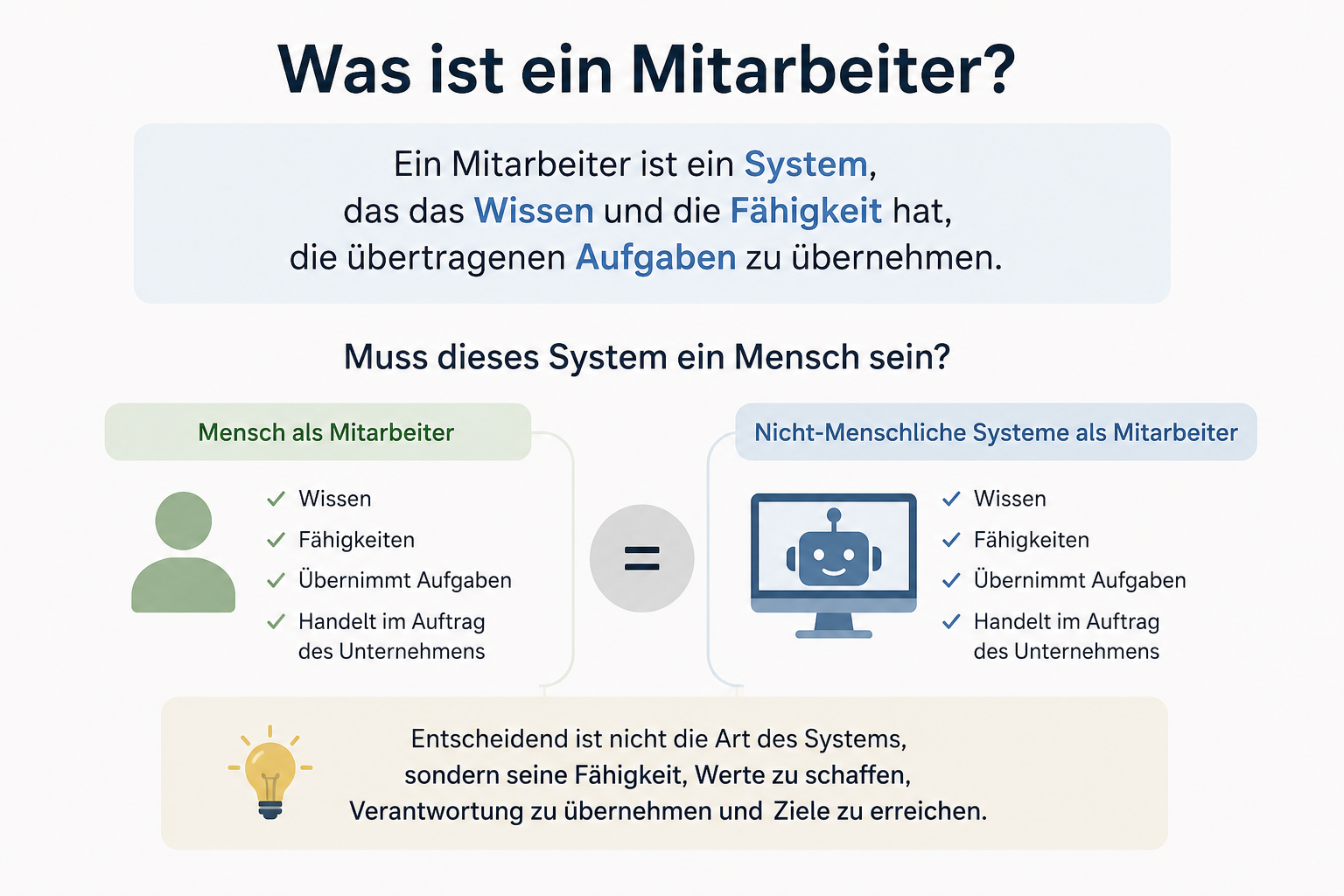
When I hire an employee, I'm not buying an employment contract. I'm buying three things:
- Knowledge — about my business, my market, my customers.
- Capability — the ability to solve a task independently from start to finish.
- Availability — when the work needs doing.
Nothing more. If a system meets these three conditions, it's an employee. Regardless of whether it breathes.
Does an Employee Have to Be Human?
Ask yourself this question seriously. Not philosophically — operationally.
- If a system answers 200 emails a day, with context, with tone, with escalation logic — is it an employee?
- If a system researches, evaluates, and contacts 80 candidates a week — is it an employee?
- If a system works at night, on weekends, without a break, without ever quitting — is it an employee?
The legal definition says: no.
Operational reality says: yes.
What Follows From This
Once you accept that "employee" is a function, not a species, your workforce planning changes fundamentally.
You stop thinking in headcount.
You start thinking in tasks.
And suddenly the question is no longer: "Who can I hire?"
But: "Which system solves this task best — human or agent?"
Both have their strengths.
Humans decide, negotiate, build trust.
Agents scale, repeat, forget nothing.
The mistake isn't making the wrong choice.
The mistake is not choosing at all — and taking both for granted.
Closing Thought
Maybe it's time for "Human Resources" to rename itself.
The term now only describes half of what actually gets work done today.
Effort × Automation = Freedom.
A question for you: How many tasks in your company truly need to be done by a human — and how many are only done by a human because "that's how we've always done it"?